
Portrait of George Templeton Strong, illustration of Manhattan in the 1860s, and scanned page of Strong’s journal (Public Domain)
Opinionated, acerbic, cranky, and often hilarious, George Templeton Strong is perhaps the greatest American diarist of the nineteenth century. A patrician lawyer and man about Manhattan, Strong penned millions of words about daily life in New York City between 1835 and 1875, encompassing everything from the smallest household matters to events of national importance: slavery, sectionalism, secession, and ultimately war.
In the recently published Civil War Diaries, editor Geoff Wisner presents a vital segment of this historic masterpiece, dedicated to Strong’s remarkable civilian record of our nation’s most devastating conflict. A recurring voice in Ken Burns’s acclaimed 1990 Civil War documentary, Strong comes alive in the new LOA edition, featuring ample never-before-published material that sheds light on his arresting voice and the world he inhabited.
Below, Wisner discusses the riches of Strong’s diaries, his commitment to the Union war effort, his eclectic interests and obsessions, and the rewards of spending time with private writings from the past.
Library of America: George Templeton Strong, despite living out much of the Civil War in New York City, did far more than just write about the conflict from a distance. In what ways did he contribute directly to the Union war effort and how did he understand his duty to the nation during these years?
Geoff Wisner: For Strong, to call someone “useful” was high praise, but he didn’t always appreciate his own usefulness. In August 1862, bemoaning his inability to do more for the war effort, he refers to himself as “poor little feeble myopic flaccid effeminate G.T.S.”
In fact, Strong made himself useful to the Union in many ways. Though he trained with a rifle company early in the war, he quickly recognized that as a nearsighted property lawyer in his forties, serving as a soldier was not the best use of his talents.

Executive Committee of the U.S. Sanitary Commission. Left to right: Dr. William Holme Van Buren, George Templeton Strong, Rev. Dr. Henry Whitney Bellows, Dr. Cornelius R. Agnew, and Prof. Wolcott Gibbs (Library of Congress)
As the treasurer of the United States Sanitary Commission, Strong managed the receipt and expenditure of donations from across the North. He made several hazardous journeys to the front lines to oversee the use of the Commission’s money, traveling on hospital ships and supply ships. He helped found the Union League Club, intended to bolster patriotic feeling in a city with many Southern sympathizers. And he helped organize benefit plays and concerts in New York City, as well as the enormous Metropolitan Fair of April 1864, which raised more than a million dollars for the relief of sick or wounded Union soldiers.
Strong’s most succinct statement of his duty to his country came in October 1862. “If we work faithfully, & do our duty in freely putting forth all our resources we can hardly fail—with God’s blessing—to crush the Rebellion & vindicate our existence as a Nation.—God enable us so to do our duty.”
LOA: Strong shows heated antipathy toward the Southern slave system and its politicians in his diaries, yet he also levies criticism at abolitionists and the Republican Party of Lincoln. What were Strong’s political views at the start of the war and how did they evolve through the conflict?
GW: For someone who joined so many organizations, Strong never seemed to find a political party he was entirely comfortable with. He began his adult life as a Whig, somewhat predictably, as Whigs were the party of the educated urban middle class. But on April 15, 1840, he writes, “Our Whig Legislators are a set of thicksculled—purblind—blundering imbeciles,” and after the election defeats of 1841 he writes, “Whiggism is done up.”

Photos of Strong in 1863 and 1864 (Public Domain)
When the Whig party tore itself apart over the issue of slavery, Strong, like most other Whigs in the North, joined the newly formed Republican Party. On September 30, 1856, he writes, “Attended a Ward-meeting last night—18th Ward republican organization—& was duly enrolled . . . . I do’nt count on success in this election—but I think it’s time now for everybody at the North to aid—as far as he can—any decent party that aims at putting down the aggressions & assumptions of our Southern friends—& to try to bring them to reason.”
Pete Hamill describes him as a handsome, melancholy man who vented his anger in his diary. That’s true, but it leaves out the fact that Strong is also funny as hell.
On December 1, 1860, he provides his best summary of his political position on the eve of the war. “Why do the people so furiously rage together just now? What has created our present unquestionable irritation against the South? What has created the Repubn party?”
He goes on, “It’s nucleus was the Abolition handful that has been vaporing for thirty years—and which till about 1850 was among the more insignificant of our Isms. Our feeling at the North till that time was not hostility to slavery, but indifference to it, & reluctance to discuss it. It was a disagreeable subject with which we had nothing to do.”
What Strong calls “our feeling at the North” is certainly a good description of Strong’s own attitude. Strong called himself a “ferocious” High Church Episcopalian, and he was reluctant to say that slavery was wrong without support from the Bible. However, he believed that slavery as it was practiced in the South was an enormous evil.

The 7th New York Militia Regiment leaving for Washington, D.C., in April 1861, and illustration of the 1863 Draft Riots (Public Domain)
LOA: Humor, self-deprecation, and quotidian detail about a bygone New York abound in the diaries. What makes Strong’s voice so compelling to our contemporary ear (he has sometimes been called the American Samuel Pepys)? How would you describe the personality and character of the man who emerges in these entries?
GW: Strong’s humor is one of my favorite things about him, and a big reason why I’ve wanted to bring him back into print. Pete Hamill describes him as a handsome, melancholy man who vented his anger in his diary. That’s true, but it leaves out the fact that Strong is also funny as hell. He is a master of snark, and that’s one reason I find it so easy to relate to him.
Sometimes Strong deploys his snark with a light touch, as he did on September 3, 1864. “Told Mr S.B.R. [Strong’s father-in-law] that I would be glad if he could somehow hint to his special friend Hon: Wash: Hunt, member of the Chicago Convention, that he was not particularly wanted as a visitor on these premises, Sunday ev’gs or weekdays, or at any time.”

Samples from the diary, adorned with photos and cartoons (The New York Historical)
LOA: Despite taking place far from the battlelines, Strong’s account features a number of major events and encounters, including the 1863 Draft Riots and meetings with Grant and Lincoln. What moments in the diary stand out for their historical significance, and what unique observations does Strong bring to bear on them?
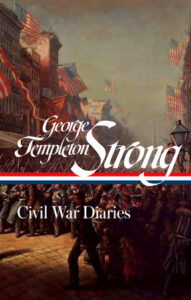
George Templeton Strong: Civil War Diaries
GW: One of my favorite scenes from the war years is Strong’s meeting with Edwin Stanton, the Secretary of War, in late March of 1864. Stanton was considered a difficult, even tyrannical man, and he resented the interference of the Sanitary Commission in Army business, calling it “a swindling concern.” Strong and his colleague Dr. Cornelius Agnew try to reach an understanding with him.
Strong writes, “Our reception was on the whole rather grim—such as a medieval Saint would have vouchsafed to the D—l, on receiving a call from that functionary.” Stanton accuses the Sanitary Commission of publishing attacks on him. Strong and Agnew deny the charge but decide it best not to go into details. “So we took the Secretary’s fire with serenity & his manner became less insolent when he found we were not much frightened.”
Strong and Agnew counter charges that the Sanitary Commission was making a profit on its operations, then tell Stanton that the Sanitary Commission would like to establish better relations with him, and take his suggestions into account. At this, Stanton “withdrew himself at once—like a startled land-tortoise, or an irritated Actinia.” As an aquarium keeper, Strong is familiar with Actinia, a type of sea anemone.
As the meeting is ending, Strong writes, “the long lean lank figure of Uncle Abraham suddenly appeared at the door. Agnew & I rose. Stanton did’nt. Lincoln uttered no word, but beckoned to Stanton in a ghostly manner with one sepulchral forefinger, & they disappeared together for a few minutes.”

Edwin Stanton as Secretary of War, 1865 (Public Domain)
LOA: The Civil War Diaries make up only part of Strong’s complete, multimillion-word manuscript housed at The New York Historical. Can you speak about the larger work this new LOA publication comes from, as well as how Strong’s writings on the war compare or stand apart from the rest of the journals he maintained through his life?
GW: As compelling as his Civil War writings are, the rest of Strong’s diary is more various, quirkier, and often funnier than anything he had to say about the war.
Strong’s keen interest in music has already been the basis for the monumental three-volume work Strong on Music by Vera Brodsky Lawrence, which brings the whole world of music in Manhattan to life, from operas at Castle Garden to the brass band at Barnum’s Museum. Unlike critics who focused on the performance of this or that baritone or soprano, Strong provides subtle analysis of the music itself, especially of the works of Beethoven, Haydn, and Mozart. About other composers he is less polite, referring to Berlioz, for instance, as a “galvanized anthropoid Parisian.”
Strong was an animal lover and an amateur naturalist, and the diary has many descriptions of his adventures with pet squirrels and cockatoos, his saltwater aquarium and microscope, and occasional experiments with hashish or chloroform. Strong visits phrenologists, psychic mediums, and art galleries, dines at Delmonico’s and the Maison Dorée, watches balloon ascensions, and comments on the work of architects.

Nineteenth-century views of Trinity Church in Manhattan, where Strong served as a vestryman for many years (Public Domain)
In March 1845 he visits Grace Church, designed by James Renwick and then under construction. He writes, “It will certainly look well when completed—and the pipestems of columns that support the clerestory will tend to impress the congregation with a sense of the uncertainty of human life & suggest profitable meditation on the Instability of things temporal.”
LOA: Anyone who’s seen the originals of the diaries knows Strong’s minuscule, occasionally inscrutable hand. What were the challenges or key questions in producing a new transcription of his work? Did you make any unexpected discoveries in your time with the New York Historical manuscript?
GW: Editing this volume was my first experience working with original manuscripts. I’ve edited several books that are drawn from Thoreau’s Journal, but in that case I had the 1906 edition of the Journal to work with, as well as the published volumes and unpublished transcripts made available by the editors of the Princeton edition. Once in a while, I’ve looked at images of Thoreau’s terrible handwriting to try to clarify something, but for the most part I haven’t had to.
In the case of Strong, I’m grateful for a couple of things. The first is Strong’s handwriting, which I find to be very clear, though very tiny. The second is that the New York Historical has made high-quality images of each page available on its website. Before that, the only way to read the diary was to go to the museum and read them on microfilm, or look at the photocopies held at the Columbia library. Once the diary was available online, I could work at home and enlarge the handwriting as much as I liked.
One of my discoveries was to find that the diary isn’t just handwriting. Strong glued in concert programs, tickets, and family photos, and he did quite a bit of doodling—not so much during the Civil War years because things were so serious, but you can find drawings of a devil, a church, a sea monster, and even a man on a rocket ship.

The four-volume Nevins edition of Strong’s diaries, published in 1952 (Abraham Lincoln Bookshop)
LOA: Roughly forty-five percent of the entries in the new LOA edition have never been published, including in the 1952 Nevins edition that was the only previous comprehensive gathering of Strong’s journals. What are some of the heretofore unseen portions included here for the first time, and how does the LOA edition “update” the Nevins edition?
GW: Allan Nevins and Milton Halsey Thomas did us all a great service by transcribing, selecting, editing, and publishing four volumes of Strong’s diary. But even those four volumes are just a fraction of the total. Their third volume is devoted to the Civil War years, but it necessarily leaves out a great deal.
The new material, I think, adds depth, detail, and emotional resonance to Strong’s chronicle. Among other things, it provides more detail on the tireless and sometimes hazardous contributions to the war effort of Strong’s wife, Ellie. It fills out the stories of Sally Baxter Hampton, the brilliant and beautiful young woman whose loyalties were tested when she married into a South Carolina family. It describes the fate of Bob Le Roy, a capable young man whose career was blighted and his life prematurely ended by his uncontrollable addiction to drink.
Probably the most shocking material left out of the Nevins edition is Strong’s account of seeing the remains of Union soldiers at Bull Run eight months after the first battle there. Strong and his colleagues hear credible accounts of Confederates keeping Union skulls as souvenirs or sawing bones to make rings.

Casualties at the First Battle of Bull Run, 1860 (Public Domain)
By comparing the Nevins material with the manuscript, I was able to correct some of the errors that inevitably creep in. Because Strong’s handwriting was so tiny, each line of text is especially long, and Nevins sometimes missed an entire line while transcribing. He misread some text as well. For instance, I’ve corrected “hogs and housing” to “hog and hominy,” “insolent” to “truculent,” “surrendered” to “sundered,” “financial grievances” to “fancied grievances,” and “Honorable Convention” to “Hen-Convention.”
The Library of America encouraged me to stick as closely as possible to the text as Strong wrote it. We chose to correct the names of people, to avoid confusion, but we’ve kept other errors or nonstandard usage, and I think it gives a special flavor to the diary. Strong’s use of capital letters gives a hint of the things he considered important. “Nation” and “Church,” for instance, are almost always capitalized. His longtime friends George Anthon and Charles Strong usually appear as G.C.A. and C.E.S., and his father-in-law Samuel Bulkley Ruggles is usually “Mr S.B.R.” For some reason Strong spelled “ancle” and “scull” with a C instead of a K.
WATCH: Geoff Wisner and Brenda Wineapple discuss Strong’s remarkable diaries
LOA: In a larger sense, what are the rewards of reading historic diaries? What can we find in this form that we can’t in novels or more general nonfiction accounts? Relatedly, Strong’s journals have often been described as “novelistic.” Do you agree with this assessment, and what do you think readers mean by it?
GW: I find historic diaries endlessly interesting, especially when they were never intended for publication. Even more than letters, which are tailored to a particular reader, diaries may be the closest we can come to being inside someone’s else’s mind. We experience the fears, secrets, and uncertainties of someone who doesn’t know how things will turn out.
Diaries do strike me as novelistic, especially if we compare them to first-person novels where the reader knows only what the narrator knows. A diary may not have a clear plot line we look for in a novel, but in Strong’s case the Civil War itself draws his day-to-day experience into the most dramatic story you could wish for.

New York’s 69th Regiment returns from the First Battle of Bull Run, 1861 (Louis Lang, Public Domain)
Geoff Wisner is the editor, most recently, of A Year of Birds: Writings on Birds from the Journal of Henry David Thoreau. His other edited books include Thoreau’s Wildflowers and Thoreau’s Animals. He is the author of A Basket of Leaves: 99 Books That Capture the Spirit of Africa. He has written for the Boston Globe, Christian Science Monitor, and the Wall Street Journal.


