Stockard Channing and Courtney B. Vance in a publicity shot for the Lincoln Center Theater production of Six Degrees of Separation (New York Public Library), portrait of John Guare (photo: Paul Kolnik), and signed Playbill for Six Degrees (eBay)
In the plays of John Guare, the fourth wall dissolves to disclose a thrilling truth: anything can happen here. In a career extending from the 1960s to the present day, this “uncannily prophetic” playwright, as Tony Kushner has called him, joins the tiny handful of living writers in the Library of America series with a new volume of his collected plays. Rife with inspired twists and gutting humor, masterpieces like the Off-Broadway breakout The House of Blue Leaves and the still-stunning Six Degrees of Separation balance unalloyed creative license with an unwavering commitment to emotional truth.
“He has stories to tell, jokes to make, logic to challenge, phrases to turn, spells to cast, all of which comprise a funhouse-mirror reflection of American life’s caprice and chaos in the twentieth and twenty-first centuries,” writes critic John Lahr in the volume’s foreword. “His proliferating imagination is a sort of Roman candle sending off noisy, exhilarating bursts of colorful light.”
Below, dramaturg Michael Paller, who with Kushner and fellow dramaturg Anne Cattaneo edited the new LOA volume, offers insight into Guare’s crazed yet familiar world of “the looming banana peel, the laughter, the pain or humiliation that follows.”
Library of America: “Few worlds are more awry than John Guare’s,” Clive Barnes wrote in his 1971 review of The House of Blue Leaves. What lies behind the madcap setups in Guare’s plays?
Michael Paller: “Madcap setups” implies, to me anyway, an expansiveness, a theatrical world three or four (or nine or ten) sizes larger than realism. Guare’s characters are defined by their oversized needs and the passion with which they strive to satisfy them, expressed with humor, strangeness, absurdity, and, most of all, determination. As his frequent collaborator Mel Shapiro noted, no one in a Guare play gives up. Expansiveness is the very DNA of his work, an expression of his sensibility, the way he reacts to life.
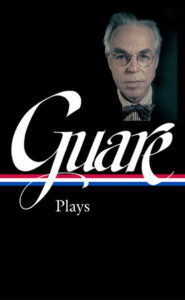
John Guare: Plays
The roots of an artist’s sensibility are not fully knowable, but in Guare’s case, there are clues, beginning with the circumstances of his growing-up. His parents, Helen and Eddie Guare, were both larger-than-life personalities. With two Irish American parents, the mood at home, he has said, was nonetheless “Sicilian. I mean completely uncensored. Nothing was held back.” If one of their favorite songs would come over the radio as they were arguing (as they often did), they’d stop and start dancing, which they loved as much as they seemed to love arguing. When the song was over, they might go back to the argument. Also, as an only child, all of his parents’ love was focused on him, sometimes uncomfortably so. He grew up in a world which was, emotionally, very large indeed.
He saw his first professional play at the age of eight: Annie Get Your Gun, with Ethel Merman. Broadway musicals are, themselves, large, madcap expressions of heightened emotion in which people suddenly burst into song and dance, expressing their heightened emotions directly to us, with an intensity unforgettable to impressionable children (and adults). Guare saw and loved many musicals as he grew up. So perhaps it’s not surprising that he’s always been attracted to the big gesture.
He also loved the great performers: the Bert Lahrs, Bea Lillies, and Rosalind Russells, whose outsized personas and the unabashed relish they took in performing required an oversized world in which to operate.

Peggy Pope and Ralph Meeker in the 1971 Off-Broadway production of The House of Blue Leaves, and William Atherton, Tom Flynn, Anne Meara, Katherine Helmond, Harold Gould, Carl Hunt, Frank Converse, Rita Karin, and Margaret Linn (on knees) in the same play (New York Public Library Digital Collections)
Seeing back-to-back performances of Feydeau’s A Flea in Her Ear and Strindberg’s Dance of Death in London in 1969 unlocked the door to the second act of The House of Blue Leaves, which had been closed to Guare for several years. The two plays featured characters whose absurdly high stakes were matched by outsized attempts to achieve them; in a sense, they were same play, about a marriage, the breathless farce of Feydeau and the scalding tragedy of Strindberg. Farce, Guare saw, was tragedy speeded up.
After The House of Blue Leaves opened, Guare told an interviewer, “Who says I have to be confined and show a guy slipping on a banana peel? Why can’t I take him to the next level and show him howling with pain because he’s broken his ass?” Pain or sorrow in one scene may be followed by laughter in the next—or in the same scene, or in the same sentence. That’s Guare’s world in a nutshell: the highest stakes, the refusal to surrender, the looming banana peel, the laughter, the pain or humiliation that follows. Alongside the laughter, the abyss.
The urge for life in this play surges upward with all its force, as through the green stalk of a plant, to find a single glint of sun; it pushes downward, resolved to tap every drop of sustenance it can reach.
LOA: Guare wrote the screenplay for Louis Malle’s 1980 film Atlantic City, which is included in this volume. What was his experience working on that movie?
MP: Guare was deeply involved in the shooting of Atlantic City. When a producer asked Malle what Guare was doing on the set every day, the director answered, “We have someone on the set for hair; why not someone for words?”

Louis Malle and Guare discussing the Off-Broadway production of Lydie Breeze (New York Public Library Digital Collections)
Director and screenwriter collaborated closely, often improvising according to what the Atlantic City locations gave them. Dave, played by Robert Joy, who steals a cache of cocaine from some major dealers, was originally to be murdered in his car, but then Guare and Malle spotted a mechanized vertical parking lot, where the cars went up and down on elevators. According to Malle, Guare said that it would be more effective if Dave were murdered at the top, with the ocean and city in the background.
They became close friends. Malle directed the world premiere of Lydie Breeze (later retitled Madaket Road) in 1982, and they planned two more films together, but neither happened before Malle died in 1995.
Watch: John Guare on the making of Atlantic City
Guare was equally involved in the making of Six Degrees of Separation, for which he wrote the screenplay based on his play. The biggest challenge there was finding a cinematic equivalent for the play’s theatricality, particularly its prominent use of direct address. In film, direct address risks becoming risible or something distinctly separate from the rest of the film’s world. Guare and the director, Fred Schepisi, found the perfect solution, retaining the play’s narrative structure and weaving it seamlessly into the world of the film.
The making of Six Degrees was a joyous affair for Guare. He was pleased with the screenplay and enjoyed working with Schepisi, whom he liked and trusted. Stockard Channing, one of his best friends, played Ouisa (she had played the role in the New York and London stage productions), and he cast some close friends, including Chuck Close, Brooke Hayward, and Peter Duchin, as well as his wife, Adele Chatfield-Taylor, in small roles (Chatfield-Taylor also appeared briefly in Atlantic City). He was happy that the film was shot in and around his favorite city, and in locations dear to him like the Metropolitan Museum of Art and the Strand bookstore.
LOA: Guare’s major themes revolve around celebrity, fame, status, and the pressure to “make it” in America. How does he see this aspirational strain in the American character?
MP: Guare has a dark view of this American dream to “make it,” to be “discovered,” to become something bigger, better, other than oneself. The question is, what makes that dream necessary in the first place?
It goes back, Guare said, to the specter of his mother’s brother, his uncle Billy Grady. In the 1920s he was a leading talent agent, representing W. C. Fields, Al Jolson, Ruby Keeler, and other big stars. From the 1930s into the ’50s, he was the casting director for MGM, whose discoveries included James Stewart, Elizabeth Taylor, and Van Johnson. Helen adored him, but Billy, now one of the most powerful men in Hollywood, had no time for her or, as Guare remembered, other “losers.” When he came to New York looking for a boy to play Huck Finn in a musical version of the Twain novel, the eight-year-old Guare “auditioned” for him in the family’s Jackson Heights apartment: spontaneously singing, dancing, standing on his head, turning somersaults—a tremendous eruption of hope and ambition that Guare was certain was his ticket to stardom. Instead it ended with Uncle Billy’s remark to his sister, “You didn’t tell me you have an idiot for a child.”

Playbills for Guare plays: Six Degrees of Separation, A Free Man of Color, The House of Blue Leaves, and the musical adaptation of Two Gentlemen of Verona (eBay)
The “audition,” the genesis for Ronnie’s Act II monologue in The House of Blue Leaves, ended any dreams Guare had of becoming an actor. However, it opened his eyes to the danger of believing, as he said, “that you had to be discovered. You were nothing until you were discovered . . . you were excluded until you were selected.” More than that, he intuited that stardom is a trap, because becoming a pop-culture star in America almost always means giving up who you are to become someone else, somebody not-you.
Once committed to, the dream of fame is hard to renounce. At the beginning of Rich and Famous, Leanara presents the playwright Bing Ringling with a pair of cufflinks, one engraved with R and the other F, for Rich and Famous. This is the night he’s been waiting for; after writing 843 plays, one is finally about to be produced, albeit “in a toilet on Lower Death Street.” He endures humiliation after humiliation chasing this dream, but he still can’t give it up. As the play ends, he tries to renounce it by throwing the cufflinks away. He removes one, which “he tosses with great resolve in front of him.” But the second one “won’t come loose. It’s a struggle. It won’t come out. He does not want to give it up. He can’t give up that final cufflink. He lowers his hands in dismay.” However much he realizes the hollowness of the dream, he can’t shake it.

Ron Leibman and William Atherton in a scene from the New York Shakespeare Festival production of Rich And Famous (New York Public Library Digital Collections)
LOA: Guare has acknowledged the influence of Thornton Wilder on his early plays. What did he learn from this older playwright?
MP: What Guare got from Wilder were practical ways to transfer into straight plays the theatricality he loved in the musicals he started seeing as a child. He was attracted to plays that didn’t just imitate the way the surface of our everyday world looks, sounds, and operates—a style that I call “material realism.” These kinds of plays often take place in realistic-looking living rooms, or in kitchens with a sink from which real water actually flows (it’s odd how the most commonplace sights in our homes can elicit “oohs,” “ahhs,” and bursts of applause in a theater). They ask audiences to pretend they’re not in a theater watching actors, but peering through a window in an invisible fourth wall into some “real” person’s “real” life. Wilder gave Guare a non-musical alternative to this style, ways of getting beneath the surface of daily life to reveal something more vital.
Wilder advocated for a return to the theater of the ancient Greeks and Elizabethans, in which the stage was bare, where a play could travel swiftly anywhere in space and time, and the audience and actors admitted that they were together in a theater. On this stage, the actors could talk directly and intimately to the audience, confide in them or implicate them in the action, without awkwardly stepping away from the kitchen-sink world.
Anyone seeing Six Degrees of Separation can easily believe that Ouisa is talking only to her. Further, the empty stage lifts characters out of a specific time and place, so that, as Wilder wrote, a Juliet isn’t just one Juliet but every Juliet who ever lived (including the ones watching from the audience). Character and audiences are transported to the realm of poetry, and for Guare, restoring theater to a place of poetry is the entire purpose of his self-declared “War on the Kitchen Sink.”

Stockard Channing and James McDaniel in the Lincoln Center production of Six Degrees of Separation (photo: Brigitte Lacombe / Courtesy of Lincoln Center Theater)
His debt to Wilder is apparent again in a late play, the haunting “Woman at a Threshold, Beckoning,” which has lingered in my mind since I first read it in 2020. The LOA edition represents its debut publication, and it deserves to be read and produced. He conjures up a downtown New York City grand jury room and a teeming neighborhood in far-off Cairo from no more than “A line of people” and a chair: a universe on an empty stage. You can’t get more Wilder than that.
LOA: Much of Guare’s later work takes place in the past. What motivated his turn toward historical subject matter?
MP: Guare likes to set himself new challenges with each play; a playwright, he’s said, should always be painting himself into corners and then searching for new ways to get out. By the mid-’70s, all his plays had been set in contemporary New York, and he was tired of drawing from the same imaginative well as other playwrights. He had been spending a lot of time on Nantucket. Both of his parents’ families were from New England, and he found himself listening, imaginatively, to the shards of family history he’d heard over the years: about his father’s Aunt Tine, his great grandmother Annie Breeze, tantalizing, unfinished bits of overheard conversations and ancestral lore. Here, he thought, was material that belonged only to him, that opened new territory to explore. Out of that came the Lydie Breeze trilogy, bookended by the Civil War and the Gilded Age.
Ulysses S. Grant is the villain of the Lydie Breeze cycle, which begins at the battle of Cold Harbor. His unseen presence hovers over the plays and enables the characters to contrast his (and America’s) taste for corruption, opportunism, and bloodlust with images of their own supposed purity. “My characters needed to hate him,” Guare wrote. “I followed their lead.”
Reading Grant’s Personal Memoirs several years later complicated Grant for Guare. He was unsettled to discover not a monster but a truly modest man, and one whose direct, colloquial style foretold two great twentieth-century writers: “[Y]ou could hear Gertrude Stein in its locutions. You could hear Hemingway in its simplicity and directness.” He needed to know how the one-dimensional monster of the Lydie Breeze cycle could write “such a masterpiece.”

Cynthia Nixon and Ben Cross in a scene from the Off-Broadway production of Lydie Breeze (New York Public Library Digital Collections)
A Few Stout Individuals shows us the endgame of Grant’s struggle to finish the Personal Memoirs, battling both the cancer that would kill him and a stubborn memory that won’t release its most painful secrets. In true Guare fashion, the play combines drama with farce, and material realism with glittering journeys into Grant’s morphine-tinged memory personified by the Emperor and Empress of Japan, who had once given him a royal welcome. And once again, he limns in a national habit: our historical amnesia.
When the then artistic director of the New York Public Theater, George C. Wolfe, invited Guare to write a play about New Orleans at the time of the Louisiana Purchase in the manner of Restoration comedy, Guare enlarged his theatrical palette once again. He employed his love of history (and research) with another favorite, the plays of William Wycherley, especially The Country Wife, and their Restoration brethren. The result was A Free Man of Color. When was the last time anyone had seen a Restoration comedy on a major New York stage—let alone one that combined that sexy world with the story of the free Black citizens of New Orleans and what became of them when their city transformed from a Spanish and French to an American one in 1803? Talk about large theatrical gestures!

The 2018 EgoPo Classic Theater production of the Lydie Breeze trilogy ( photo: Dave Garrett Sarrafian / courtesy of EgoPo Classic Theater)
LOA: Of the plays included in the new LOA volume, do you have a personal favorite or recommendation for where readers new to Guare’s work might start?
MP: The House of Blue Leaves and Six Degrees of Separation are natural places to start for readers new to Guare; they have connected deeply with audiences since their first performances, because they are in part about outsiders longing to be insiders. Both answer in the affirmative the question Guare asks in his Foreword to Blue Leaves: “Why shouldn’t Strindberg and Feydeau get married, or at least live together…?” They should, and they do in these two plays.
Blue Leaves is about a man whose delusional dreams of fame destroy his family, and yet it is screamingly funny. Six Degrees actually invites us to be insiders: “Tell them!” Ouisa commands her husband, Flan, in the first line, and for the next ninety minutes they do. It’s a play with a deep longing in its soul and an unsolvable mystery at its heart: who is Paul? But from those depths emanate the laughter of recognition, and also its denial. Both plays exist in a tension that has given rise to so much of Guare’s best work: between the pain of having a family and the pain of not having one.
Out of that same tension came Landscape of the Body. It’s a rich play, crammed with longing, love, grisly murder, absurd disguises, sudden death, and cabaret songs sung by the dead sister of the play’s protagonist, Betty Yearn. It also features one of Guare’s most tender scenes, which may remind readers of a similar mother-son scene in The Seagull. What moves me most about the play is how fiercely life and death contend. Death is around every corner, but the characters insist on living. In the face of tragedy, Betty refuses to give up. “And this is the only thing I know,” she says. “There’s got to be some order in there.” The urge for life in this play surges upward with all its force, as through the green stalk of a plant, to find a single glint of sun; it pushes downward, resolved to tap every drop of sustenance it can reach. No wonder Guare has such admiration for the plays of Tennessee Williams, whose characters need to “live, live, live, live, live.”

Jeffrey Wright in the Lincoln Center production of A Free Man of Color, directed by George C. Wolfe (photo: T. Charles Erickson / Courtesy of Lincoln Center Theater)
If I were forced to choose one play in this volume to take with me to the proverbial desert island, it would be the second play of the Lydie Breeze cycle, AIPOTU. It’s the story of a chosen family who, after surviving the horrors of the Civil War, hope to make a utopian society on Nantucket, but all the ideals in the world are finally no match for a universe in which, as Lydie warns her children, “Anything can happen.”
It opens on a sunny Nantucket beach where the possibilities seem as endless as the horizon, and ends in a dank Charleston prison cell, across the river from Boston, with the hopes of all but one of the utopians dashed. That character, once the lowliest member of the colony, is about to rise to political heights that no one could have dreamed of on that sunlit beach. The play’s vision is tragic, yet it never gives up its wryly humorous wisdom, and radiates a generosity of spirit that helps make existence bearable in such a bruised and bruising world.
Michael Paller was the dramaturg and director of humanities at the American Conservatory Theater and is the author of Gentlemen Callers: Tennessee Williams, Homosexuality, and Mid-Twentieth-Century Drama, Williams in an Hour, and A Five-Act Play: Fifty Years of A.C.T.