James Weldon Johnson Sarah Orne Jewett Thomas Jefferson James Baldwin Washington Irving Zore Neale Hurston William Dean Howells Nathaniel Hawthorne Dashiell Hammett Alexander Hamilton Ulysses S. Grant
American Literature by American Writers.
Sign up for E-Mail View CartMy Account
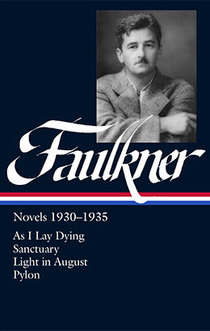
Faulkner, William - Novels 1930–1935
Shopping & Subscriptions
News
Gifts & Donations
About LOA
Features
Home

William Faulkner

Novels 1930–1935

As I Lay Dying • Sanctuary • Light in August • Pylon

 
"Thanks now to Faulkner scholars Joseph Blotner and Noel Polk and The Library of America, we have Faulkner's Faulkner. We also have in this volume the best chronology on the man that we've seen."
—Nashville Banner
 
Overview  |  Note on the Texts  |  Reviews  |  Table of Contents
 

This volume reproduces the texts of As I Lay Dying, Sanctuary, Light in August, and Pylon that have been established by Noel Polk for publication by Faulkner's publisher. All texts are based upon Faulkner's own typescripts, which have been emended to account for his revisions in proof, his indisputable typing errors, and certain other errors and inconsistencies which clearly demand correction. The underlying holograph manuscript for each work has been consulted regularly throughout the editorial process; indeed, comparison has been made of all extant forms of these titles, published and unpublished, to determine what variants exist among the texts and why they exist. The goal of these labors, to discover the form of these works that Faulkner wanted in print at the time of their original publication, is frequently elusive. Although thousands of pages of typescript and manuscript and proof are available to the editor, it is not always clear what Faulkner's final intentions were, or even whether Faulkner had any "final" intentions regarding the individual component parts of his novels.

Copy-texts for these four novels are his own ribbon typescript setting copies. Faulkner typed and proofread these documents himself, with varying degrees of care; all of them bear his own holograph corrections and revisions. They also bear alterations of varying degrees of seriousness by his editors. Faulkner was in some ways an extremely consistent writer. He never included apostrophes in the words "dont," "wont," "aint," "cant," or "oclock," and very seldom used an apostrophe to indicate a dropped letter at the beginning or end of a spoken dialect word, such as "bout" or "runnin." He never used a period after the titles "Mr," "Mrs," or "Dr". The original editors generally accepted these practices (though the editor of Light in August did not accept "oclock" and the editor of Pylon did not accept "cant"), but the compositors often made mistakes and many apostrophes slipped in. A more serious problem was the editors' treatment of punctuation. The editors of Pylon, for example, made all of Faulkner's dashes into ellipses. They also frequently inserted commas into monologues where Faulkner was deliberately attempting to give the effect of spoken language. They occasionally broke up long sentences, and combined short sentences. Faulkner's compound words were also often changed--for example "oftenbrushed" and "flatvoiced" might become "often brushed" and "flat-voiced"--and some words he left separate were joined--"before hand" might become "beforehand," "down stream" become "downstream." Most of the editorial alterations in As I Lay Dying, Sanctuary, and Light in August are of these relatively minor types. Editorial intervention in Pylon, however, might well be called wholesale revision.

Faulkner's attitude toward such intervention is neither consistent nor entirely clear, though one might say, to put it oversimply, that he seems to have appreciated it when editors did something he liked and resented it when they did something he did not like. Almost from the beginning of his career, Faulkner was a supremely confident craftsman; he was at the same time also aware of the complexity of the demands his work would make not merely on the reader but also on publisher and editor and proofreader. His response to Ben Wasson's tampering with the Benjy section of The Sound and the Fury--that he would rewrite it if publishing were not grown up enough to publish it as he wanted it--reflects a very complex combination in his attitude of flexibility toward the realities of publication and of impatience with those mechanical processes of publication beyond his control that might thwart the accomplishment of his high artistic goals. His response also very specifically displays an irritation with the editors of this period who failed to understand what he was trying to do. He seems to have been indifferent to some types of editorial changes, and so he acquiesced to them: he sometimes simply did not care whether a semicolon became a full stop, or a long sentence or paragraph were shortened; he seems not to have cared whether certain words were spelled consistently or not, whether certain of his archaisms were modernized or not; and he seems to have expected his editor to divine from his typing whether each sentence was punctuated exactly as he wanted it--that is, whether or not a variation from an apparent pattern was in fact a deliberate variation or merely an inadvertency an editor should correct. Thus while some of his marks on galley and page proofs were genuine revisions of his own, many others were attempts to repair damage of one sort or another made by another hand on the typescript setting copy.

With the benefit of hindsight and decades of intense scholarship, we are now in a better position to understand Faulkner's intentions than the original editors were, although clearly many of the original editorial problems remain. The Polk texts attempt to reproduce Faulkner's typescripts as he presented them to his publishers before editorial intervention. They accept only those revisions on typescript or proof that Faulkner seems to have initiated himself as a response to his own text, not those he made in response to a revision or a correction suggested by an editor; this is a very conservative policy which rejects many of Faulkner's proof revisions in favor of his original typescript.

While every effort has been made to preserve Faulkner's idiosyncrasies in spelling and punctuation, certain corrections of the typescript have been necessary. Unmistakable typing errors and other demonstrable errors have been corrected. Faulkner's punctuation has been regularized in two cases: except for using three hyphens (---) to indicate a one-em dash, Faulkner was inconsistent throughout his career in the number of hyphens he typed to indicate a dash longer than one em, and in the number of dots he typed to indicate ellipses; he frequently typed as many as twelve or thirteen hyphens or dots. In the Polk texts, three or four hyphens become a one-em dash, five or more become a two-em dash; up to six dots of ellipses are regularized to three or four according to traditional usage, seven or more become seven. Accent marks have been added to foreign words where appropriate.

According to Faulkner's sarcastic testimony in his notorious introduction to the Modern Library Sanctuary in 1932, he wrote As I Lay Dying "in six weeks, without changing a word." The manuscript and typescript reveal that he did not, of course, write it "without changing a word," although the dates on the manuscript indicate that he did indeed complete the holograph version in about eight weeks, between October 25 and December 29, 1929. "I set out deliberately to write a tour-de-force," he claimed later. "Before I ever put pen to paper and set down the first words I knew what the last word would be. . . . Before I began I said, I am going to write a book by which, at a pinch, I can stand or fall if I never touch ink again." He wrote As I Lay Dying at the University of Mississippi power plant, where he was employed as fireman and night watchman, mostly in the early morning, after everybody had gone to bed and power needs had diminished. He finished the typing, according to the date on the carbon typescript, on January 12, 1930, and sent it to Harrison Smith, who published it with very few editorial changes on October 6, 1930.

Extant documents relevant to the editing of As I Lay Dying are the holograph manuscript and the carbon typescript, at the Alderman Library of the University of Virginia, and the ribbon typesetting copy, at the Humanities Research Center of the University of Texas. No proof is known to survive; this is unfortunate, since there are a number of differences between the typescript and published book that must have occurred in proof. Copy-text for the Polk edition is the ribbon setting copy.

Sanctuary is a problematic novel in the Faulkner canon, partly because his introduction to it for its 1932 appearance in the Modern Library stresses its deliberate sensationalism and exploitation of "current trends" in literature for financial gain. After four novels which did not make him any money, he wrote: "I began to think of books in terms of possible money. I decided I might just as well make some of it myself. I took a little time out, and speculated what a person in Mississippi would believe to be current trends, chose what I thought was the right answer and invented the most horrific tale I could imagine and wrote it in about three weeks and sent it to Smith." Evidence from the holograph manuscript, however, completely refutes Faulkner's claim of haste and carelessness. This manuscript, among the two or three most complex documents in the Faulkner archive, preserves the painstaking effort, the thousands of revisions, the hundreds of shifts of large bodies of material and small that went into the composition of Sanctuary. We also know, despite his claim that he "took a little time out" and "speculated" about what to write, that the materials of Sanctuary reach further back into Faulkner's life (he had heard a story about a gangster named Popeye from some bootlegging friends), and that as early as 1925 while in Paris he wrote a long passage that was to become part of the novel's ending. Thus Faulkner's introduction to the Modern Library Sanctuary should properly be taken as a sardonic response to critics' charges that his work was sloppy and undisciplined--a response in particular to reviewers of Sanctuary who could not see past its sensational elements into its seriousness.

As Faulkner and legend would have it, Smith, upon reading Sanctuary, responded, "Good God, I can't publish this. We'd both be in jail." Faulkner then worked on As I Lay Dying and numerous short stories and was surprised some months later when Smith sent him galleys. "Then I saw that it was so terrible that there were but two things to do: tear it up or rewrite it. I thought again, 'It might sell; maybe 10,000 of them will buy it.' So I tore the galleys down and rewrote the book." Like other elements of Faulkner's account of Sanctuary, this one also begs a number of questions and does not tell the complete truth. Although it is not at this point clear what the complete truth is--why, that is, Smith originally delayed publication--we may assume, from information provided by Joseph Blotner's one-volume Faulkner: A Biography (New York: Random House, 1984), that Smith and Faulkner 's agreement about its publication and that of As I Lay Dying were tied up with money that Smith lent Faulkner as an advance so that he could get married. Whether he revised the novel because he thought it was "terrible," as he claimed, or if there were perhaps other reasons for the revision, and whether he improved the novel in revision, are questions scholars are just now beginning to investigate.

Faulkner's revision of Sanctuary, like the original writing, was a very complex process: some large bodies of material he retyped and pasted to the existing galleys in appropriate places; he shifted material already set in type from one galley to another; other portions of the galleys he simply corrected in ink. As a major example of the kinds of revisions Faulkner made, one may note that the novel's opening scene, the long confrontation between Horace Benbow and Popeye across the spring, was originally tucked away in chapter II; Faulkner retyped the scene, changed its point of view from Horace's to Popeye's, and moved it to the beginning of the novel. The novel's original opening, Horace's meditation on the Negro murderer in the Jefferson jail, became chapter XVI of the revised version.

Extant documents relevant to the editing of Sanctuary are the holograph manuscript, the carbon typescript, and a set of the original uncorrected galley proofs, all at the Alderman Library of the University of Virginia; the ribbon typescript setting copy at the University of Mississippi; and the corrected galleys, at the Humanities Research Center of the University of Texas. The manuscript of Sanctuary bears the dates January-May 1929; the carbon typescript is dated, on the final page, May 25, 1929. The revisions in galley took place in the late summer of 1930. Jonathan Cape and Harrison Smith published the novel on February 9, 1931.

Copy-text for the Polk edition of Sanctuary consists of the new typescript appended to the old galleys and the original typescript underlying those portions of the galley text which he allowed to stand as set or as revised by hand. Typescript of the original version is used wherever possible in order to avoid editorial and compositorial errors that may have crept into the original typesetting. Differences between the published book and the revised galleys imply that someone made further changes on a second set of galleys, now missing, pulled after the revisions had been set; all of these additions are complete sentences and seem clearly to be Faulkner's additions. Some regularizing has been necessary; Faulkner's usage changed somewhat over the eighteen months between the original writing and the revision: he was very explicit, for example, in altering the original's "suitcase" to "suit case" several times, though he did not catch them all; he invariably typed "whisky" in the original typescript, "whiskey" in the new. Such simple alterations have been regularized in favor of the newer version. Other cases are more complicated: Tommy's dialect, for example, is noticeably different in the later version; these inconsistencies have been allowed to stand except in one passage (p. 193) where the final "g" has been deleted from several "ing" words so as not to have Tommy's use of "ing" in some words and of "in" in others distort the reader's sense of Tommy's dialect pronunciation.

According to the dates on the manuscript, Faulkner began a novel called Dark House on August 17, 1931; the finished manuscript, completed February 19, 1932, was called Light in August. The typescript was only minimally marked by editors. Faulkner made several minor changes in proof. The novel was published on October 6, 1932. Extant documents relevant to the editing of Light in August include the holograph manuscript and the larger portion of the typescript setting copy (pp. 1-470), at the Alderman Library of the University of Virginia; the final pages (471-527) of the setting copy and the corrected galleys are in the Humanities Research Center of the University of Texas. Copy-text for the Polk edition is Faulkner's typescript.

In October 1934 Faulkner began writing Pylon, as a respite, he said, from his work on Absalom, Absalom!, which had grown "inchoate." He wrote Pylon very rapidly, sending chapters to Hal Smith as he typed them, between November 25 and December 15, 1934; he did a good deal of revising in galleys. Smith and Haas published it on March 25, 1935. The editors at Smith and Haas made many changes in this text: they bowdlerized; they shortened sentences and paragraphs and clarified and simplified whenever they thought appropriate; sometimes they queried Faulkner, sometimes not; sometimes he replied to their inquiries and changes, sometimes he did not. The galleys of this novel are thus extremely interesting, in that they are full of Faulkner's and his editors' revisions and exchanges. Many of Faulkner's changes on these galleys are efforts to repair damage done to the typescript by these editors. For example, the long paragraph beginning on page 836 (ending on page 840), a flashback detailing an encounter between Hagood and the reporter's mother and a related encounter between Hagood and the reporter, was typed by Faulkner as a single paragraph; Faulkner did this to separate it typographically and visually from the rest of the text. It occurs abruptly in the middle of a conversation between Hagood and Jiggs; the text reverts to that same conversation at the end of the flashback with no other signal than Faulkner's paragraph break. The editors at Smith and Haas, however, broke the long paragraph into numerous smaller, conventional ones, destroying the visual effect Faulkner intended. When confronted with the reparagraphing in galleys, Faulkner, at least as far as available evidence would indicate, did not try to restore the passage to its original form, but noted instead some confusion about the transition from the flashback into present time, and so rewrote the first paragraph following the flashback, adding, "But that was eighteen months ago, now Hagood and Jiggs stood side by side . . ." The Polk text does not take Faulkner's acquiescence to the reparagraphing to indicate his full approval of it, but rather to indicate his professional willingness to recognize that there might be more than one way to accomplish his general aims. Because this was not an original inspiration, but rather a simple and efficient repair of damage the editors had done, the Polk text restores the typescript's long paragraph and rejects Faulkner's revision of the succeeding paragraph. The typescript and galleys present numerous such problems. Many other changes were generated by Faulkner's response to the text as he saw it set in type for the first time. The Polk text tries to distinguish the latter from those caused by editorial intervention, although it is not always easy to do so. The reader familiar with the first edition of Pylon will find the Polk text considerably different in a number of significant respects.

Extant documents relevant to the editing of Pylon are the typescript setting copy at the University of Virginia's Alderman Library and the corrected galleys at the Humanities Research Center of the University of Texas. The holograph manuscript, at the University of Mississippi, is incomplete. Polk's copy-text is Faulkner's typescript setting copy.

American English continues to fluctuate; for example, a word may be spelled in more than one way, even in the same work. Commas are sometimes used expressively to suggest the movements of voice, and capitals are sometimes meant to give significances to a word beyond those it might have in its uncapitalized form. Since standardization would remove such effects, this volume preserves the spelling, punctuation, capitalization, and wording of the texts established by Noel Polk, which strive to be as faithful to Faulkner's usage as surviving evidence permits. In this volume the reader has the results of the most detailed scholarly efforts thus far made to establish the texts of As I Lay Dying, Sanctuary, Light in August, and Pylon.

Copyright 1995–2007 Literary Classics of the United States, Inc.
Contact Us | Privacy and Security

LOA Web Store
List price: $35.00
Web store price: $31.50
ADD TO CART
Free shipping in the U.S.
Phone orders: 1-800-964-5778
Request product #200255
Subscription Account Holders: Buy the cream-slipcased edition at the Customer Service Center.
ISBN: 978-0-94045026-4
1034 pages
More purchasing options
Amazon.com
Barnes and Noble
Powells.com
Other options

Make a tax-deductible gift of volumes to a library of your choice.