Dashiell Hammett Alexander Hamilton Ulysses S. Grant Robert Frost Benjamin Franklin Scott F. Fitzgerald William Faulkner James T. Farrell Ralph Waldo Emerson W.E.B Du Bois Theodore Dreiser Fredrick Douglas
American Literature by American Writers.
Sign up for E-Mail View CartMy Account
Cooper, James Fenimore - The Leatherstocking Tales: Volume Two
Shopping & Subscriptions
News
Gifts & Donations
About LOA
Features
Home

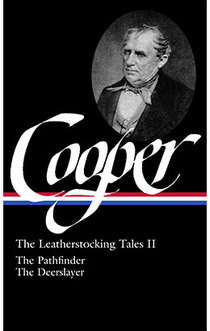
James Fenimore Cooper

The Leatherstocking Tales: Volume Two

The Pathfinder • The Deerslayer


Overview  |  Note on the Texts  |  Reviews  |  Table of Contents
 

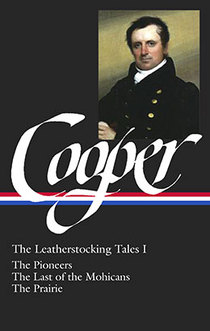
This volume contains the last two of James Fenimore Cooper's five Leatherstocking Tales: The Pathfinder (1840) and The Deerslayer (1841). A companion volume contains The Pioneers (1823), The Last of the Mohicans (1826), and The Prairie (1827). The texts reprinted here are those established for The Writings of James Fenimore Cooper under the general editorship of James Franklin Beard, with James P. Elliott as textual editor, and published by the State University of New York Press, Albany (hereafter referred to as the SUNY edition): The Pathfinder (1981) and The Deerslayer(1987). These texts were prepared according to the standards established by--and they have received the official approval of--the Center for Editions of American Authors (or its successor, the Center for Scholarly Editions) of the Modern Language Association of America (see The Center for Scholarly Editions: An Introductory Statement, 1977). The aim of the SUNY edition is to establish a text that as nearly as possible represents the author's final intentions. In selecting their copy-text, the editors give priority to the holograph manuscript, in whole or part, when it exists; when it does not survive, preference goes next to proofs corrected in the author's hand, or, if these do not exist, to the editions Cooper is known to have supervised or revised. Though circumstances beyond his control frequently defeated his intentions, Cooper was a painstaking reviser who corrected compositorial errors, rewrote sentences and phrases, altered punctuation and spelling (his own punctuation and spelling were not always consistent), sharpened diction, and in particular resisted the attempts of editors, compositors, and amanuenses to normalize dialect expression (e.g. " 'arth" to "earth," "ag'in" to "again," "Injin" to "Indian").

Cooper's decision to return to Leatherstocking some thirteen years after he had recounted his death and burial in The Prairie must be credited in part to a suggestion from his English publisher, Richard Bentley. In a letter of April 6, 1839, Bentley proposed that the novelist "undertake a naval story on your own inland Seas." Cooper readily complied. By June he was at work on what he described to Bentley as his "nautico - lake -savage romance," The Pathfinder. On October 19 he reported to his wife from Philadelphia, where he had gone to be near his American publisher, that the first volume was being printed but that the second was not yet written. He finished the novel in December, and the printing was completed in January 1840. To protect the British copyright, the English edition, published by Richard Bentley February 24, 1840, preceded the American edition, published March 14 in Philadelphia by Lea and Blanchard.

Fortunately, the holograph manuscript of The Pathfinder: or, The Inland Sea survives and is now in the University of Virginia Library. It serves as the copy-text for the SUNY edition. The first American edition was set from Cooper's manuscript and is the first authorial edition. Cooper made many alterations in the proofs of the first edition to simplify expression, clarify meaning, improve diction, add information, correct names, and, as was habitual with him, increase and refine dialect forms. The manuscript (which was needed to protect the British copyright) and proof sheets were then sent on to Bentley. Bentley, following Cooper's explicit instructions, set the English edition from the Lea and Blanchard proofs. In the rush to complete the work, Cooper made corrections in the proof sheets of the introduction sent to England that he apparently failed to make in the American edition. The introduction in the English edition, therefore, is authoritative. The second authorial edition appeared in Putnam's Author's Revised Edition in 1851. Though Cooper apologized in the preface to that edition for the many errors remaining in the first edition, most of them the result of compositorial misreadings, this second edition retained most of the first edition's misreadings and introduced nearly two hundred non-authorial readings. Cooper restored forty-nine manuscript words or phrases, and corrected dialect forms: for example, "real" be-comes "raal," "concerning" becomes "consarning," "girls" becomes "gals." He also added a new preface, as he had done for other works in this edition. As a result, the text of The Pathfinder, like that of the other Leatherstocking Tales, did not achieve an approximation of what would have been Cooper's final intentions during his lifetime. The SUNY textual editor, Richard Dilworth Rust, collated all the relevant documents and determined which variants were intended by Cooper, and which were caused by compositorial misreading or editorial intervention. The intended emendations were then inserted into the copy-text.

Presumably Cooper was well into the composition of The Deerslayer: or, The First War-Path on November 10, 1840, when he wrote to Richard Bentley proposing terms for the novel, which, he indicated, "will contain the early life of Leatherstocking--a period that is only wanted to fill up his career." At the end of January 1841, he informed Bentley that the work was nearly half finished and that he was considering several alternative titles : " 'Judith and Esther, or, the Girls of the Glimmerglass.'--'Wah! -Ta-Wah!, or, Hist! -Oh! -Hist!' 'The Deerslayer, or a Legend of the Glimmerglass.' &c &c. In some respects I prefer the last--" By early July, Bentley had received the manuscript and duplicate proof sheets, together with Cooper's request that the novel be published as early in September as possible. Lea and Blanchard published The Deerslayer in Philadelphia on August 27, 1841; Richard Bentley brought out the British edition on September 7. (In this case, Bentley seems not to have had any problem in maintaining the British copyright.)

The copy-text for The Deerslayer is the corrected holograph manuscript, now in the Pierpont Morgan Library, from which the first American edition was set. Because of Cooper's overcrowded and interlineated manuscript, the compositors at Lea and Blanchard made a number of significant misreadings that Cooper, despite his careful proofreading, failed to correct. Though no page proofs of the Lea and Blanchard edition are known to survive, it is clear from Cooper's correspondence that he made revisions that were incorporated into that text. The Lea and Blanchard edition of 1841 is therefore the first authorial edition. The second is the Putnam's Author's Revised Edition of 1850. The Deerslayer was the first of the Leatherstocking Tales to appear in this edition, and Cooper wrote for it a general "Preface to the Leather-Stocking Tales." This preface has been included in the SUNY edition. As with the other Leatherstocking Tales in the Putnam series, the revisions were not extensive and were limited mainly to correcting grammatical errors, tightening style, and, as always, insisting on the preservation of dialect forms. The SUNY textual editors, Lance Schachterle, Kent P. Ljungquist, and James A. Kilby, collated all the relevant documents and determined which variants were intended by Cooper.

The standards for American English continue to fluctuate and in some ways were conspicuously different in earlier periods from what they are now. In nineteenth-century writings, for example, a word might be spelled in more than one way, even in the same work, and such variations might be carried into print. Commas were sometimes used expressively to suggest the movements of voice, and capitals were sometimes meant to give significances to a word beyond those it might have in its uncapitalized form. Since modernization would remove such effects, this volume preserves the spelling, punctuation, capitalization, and wording of the SUNY edition, which strives to be as faithful to Cooper's usage as surviving evidence permits.

This volume offers the reader the results of the most detailed scholarly effort thus far made to establish the texts of The Pathfinder and The Deerslayer The present edition is concerned only with representing the texts of these editions; it does not attempt to reproduce features of the typographic design--such as the display capitalization of chapter openings. Epigraphs from Shakespeare have been keyed by the SUNY editors to The Riverside Shakespeare, ed. G. Blakemore Evans (Boston: Houghton Mifflin, 1974); other epigraphs are keyed to unspecified "standard editions," "first editions," or "early American editions" available to Cooper at the time he wrote the Tales.

Copyright 1995–2007 Literary Classics of the United States, Inc.
Contact Us | Privacy and Security

LOA Web Store
List price: $40.00
Web store price: $32.00
ADD TO CART
Free shipping in the U.S.
Phone orders: 1-800-964-5778
Request product #200271
Subscription Account Holders: Buy the cream-slipcased edition at the Customer Service Center.
ISBN: 978-0-94045021-9
1051 pages
More purchasing options
Amazon.com
Barnes and Noble
Powells.com
Other options

Make a tax-deductible gift of volumes to a library of your choice.