|
||||||||||||||||
|
|
|
|
|
|
|
|
|
|
|
|
|
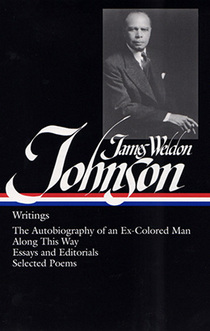
James Weldon JohnsonWritingsThe Autobiography of an Ex-Colored Man • Along This Way • essays and editorials • selected poems
"The Autobiography of an Ex-Colored Man established James Weldon Johnson as the first truly modern black American novelist, while his Along This Way, published two decades later (in 1933), recounted his rich life as a diplomat, journalist, songwriter, and secretary to the NAACP. This collection of his writings, which includes both of those longer works plus several rare essays, poems, and songs, is yet another important volume in The Library of America series."
— Dallas Morning News James Weldon Johnson's career was one of extraordinary range, spanning the worlds of diplomacy (as U.S. consul in Venezuela and Nicaragua), politics (as Secretary of the NAACP), journalism (as founder of one newspaper and longtime editor of another), musical theater (as lyricist for the Broadway songwriting team of Cole and Johnson Brothers), and literature (as novelist, poet, and anthologist). At the dawning of what would become the modern civil rights movement, he forged a record of accomplishment that defied the odds. The Library of America now presents a collection of his writings that displays the many facets of a complex and impassioned writer. The Autobiography of an Ex-Colored Man (1912), Johnson's first book, is a novel thatwhich on its original anonymous publication was taken by many for an actual memoir. A groundbreaking work of modern fiction, it powerfully describes the inner development of a gifted, socially alienated man as he tries to come to terms with the constraints of racism. Along This Way (1933) is Johnson's genial and enthralling account of his fantastically busy life, with a cast of characters including W.E.B. Du Bois, Paul Robeson, Clarence Darrow, Booker T. Washington, Theodore Roosevelt, Carl Van Vechten, and many others. A selection of shorter prose—editorials from The New York Age, political essays, literary prefaces, an excerpt from the historical study Black Manhattan—confirms the variety of Johnson's interests, as he comments on figures and topics including Jack Johnson, Marcus Garvey, Woodrow Wilson, lynching, anti-Japanese discrimination in California, American involvement in Haiti, changing trends in theater and poetry, and the significance of spirituals. Johnson's poetry is represented by the full text of God's Trombones (1927), his stirring homage to African-American preaching, and shorter works including "O Black and Unknown Bards," lyrics from Johnson's Broadway songwriting days, and "Lift Every Voice and Sing," the hymn often referred to as the "Negro National Anthem." William L. Andrews, volume editor, is E. Maynard Adams Professor of English at the University of North Carolina at Chapel Hill, general editor of The Literature of the American South: A Norton Anthology, and co-editor, with Henry Louis Gates Jr., of The Library of America's Slave Narratives.
Also of Interest:
Copyright 1995–2007 Literary Classics of the United States, Inc. |
|
List price: $40.00
Web store price: $20.00
Free shipping in the U.S.
Phone orders: 1-800-964-5778
Request product #201535
Subscription Account Holders: Buy the cream-slipcased edition at the
Customer Service Center.
ISBN: 978-1-93108252-5
906 pages |