|
||||||||||||||||
|
|
|
|
|
|
|
|
|
|
|
|
|
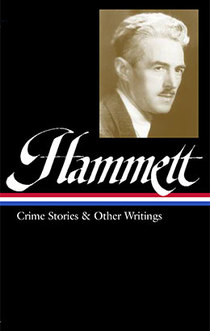
Dashiell HammettCrime Stories and Other Writings
"Steven Marcus has gone back to Hammett's original magazine versions, so that even much-anthologized stories here take on an unfamiliar cast, like old friends newly paroled."
San Francisco Chronicle This volume presents, in the order of their first publication, a selection of 24 crime stories by Dashiell Hammett, followed by "The Thin Man: An Early Typescript" (an unfinished novel in ten chapters), and two short pieces about detective work and detective fiction. All of the stories included in this volume appeared initially in magazines, principally in the pulp Black Mask (titled The Black Mask until early in 1927), where Hammett also first published Red Harvest (1929), The Dain Curse (1929), The Maltese Falcon (1930), and The Glass Key (1931). For a brief period, Hammett considered revising his stories and collecting them in book form. In a letter of June 16, 1929, to Harry Block, his editor at Alfred A. Knopf, he suggested two possible volumes, The Continental Op (a collection of stories featuring his character of the same name) and The Big Knock-Over (to include "The Big Knock-Over"and the related story "$106,000 Blood Money"). "I'd want to rewrite the stories," he told Block, "and there are possibly fifty or sixty thousand words out of the quarter-million that I'd throw out as not worth bothering about. In the remainder there are some good stories, and altogether I think they'd give a more complete and true picture of the detective at work than has been given anywhere else." Within a month, however, Hammett had reconsidered; "I don't think I want to do anything with them," he wrote Block again on July 14, 1929. Hammett continued to decline Knopf proposals over subsequent years to publish story collections, but he did allow his stories to appear in print elsewhere: in magazine anthologies, in newspaper syndication (through King Features), and in paperback collections, the first series of which was published by Lawrence E. Spivak in New York beginning in 1943, edited by Ellery Queen (a pseudonym used jointly by Frederick Dannay and Manfred B. Lee). Two stories included in this volume, "The Golden Horseshoe" and "Dead Yellow Women," appeared in a British hardcover collection, The Dashiell Hammett Omnibus (London: Cassell, 1950), along with Hammett's novels. Numerous textual changes, large and small (including alterations to titles, substantial verbal revision, and the omission of sentences and paragraphs), are introduced in these later reprintings. In almost all cases, Hammett is known not to have been or is not likely to have been responsible for these changes. As William F. Nolan comments in Hammett: A Life at the Edge, "Aside from the money he received from these collections of his early fiction, Hammett had nothing to do with them. He did not revise the works as they went into book form." He did suggest, in a letter to Lillian Hellman written from the Aleutian Islands on July 26,1944, that the story "Two Sharp Knives" be retitled "To a Sharp Knife" when it appeared in book form; the latter was Hammett's original title, the former "thought up by Collier's" where the story was first published. With one exception, this volume reprints Hammett's stories from their initial magazine printings. No copy is known to be extant of the issue of the pulp magazine Mystery Stories in which "This King Business" initially appeared, in January 1928; it is reprinted here from The Creeping Siamese (New York: Lawrence E. Spivak, 1950), the first book version. Two stories in this volume, "Arson Plus" and "Slippery Fingers," were published in Black Mask under the pseudonym Peter Collinson. The following list gives details about the first serial and first book versions of each of the stories included in this volume; when the first book version is a collection of the work of various authors, the first appearance in a Hammett collection is also noted: Arson Plus
Dead Yellow Women
"The Thin Man: An Early Typescript" has been reprinted from Hammett's original typescript, in the Guymon Collection, Mary Norton Clapp Library, Occidental College Library, Los Angeles. A handwritten note accompanying the typescript, signed by Hammett and dated Hardscrabble Farm, Pleasantville, N.Y., January 14, 1942, explains the unfinished novel's relation to The Thin Man: In 1930 I started writing a book entitled "The Thin Man." By the time I had written these 65 pages my publisher and I agreed that it might be wise to postpone the publication of "The Glass Key"scheduled for that falluntil the following spring. This meant that "The Thin Man" could not be published until the fall of 1931. Sohaving plenty of timeI put these 65 pages aside and went to Hollywood for a year. One thing and/or another intervening after that, I didn't return to work on the story until a couple of more years had passed and then I found it easier, or at least generally more satisfactory, to keep only the basic idea of the plot and otherwise to start anew. Some of the incidents in this original version I later used in "After The Thin Man," a motion picture sequel, butexcept for that and for the use of the characters' names Guild and Wynantthis unfinished manuscript has a clear claim to virginity. The unfinished "Thin Man" remained unpublished during Hammett's lifetime, and no other manuscript version is known to be extant; it first appeared in print in its entirety in City Magazine 9. (November 4, 1975): 1-12(insert). "From the Memoirs of a Private Detective" is reprinted here from The Smart Set (March 1923, pages 87-90), where it was first published; Hammett did not make further revisions to this work. "'Suggestions to Detective Story Writers' " has been assembled from two installments of "The Crime Wave," a book-review column Hammett contributed to the New York Evening Post between April and October of 1930; its first section (from 910.1 to 911.39 in this volume) reprints all but the title, list of books reviewed, and opening paragraph of the review of June 7, 1930, and its second (from 912.1 onward in this volume) reprints the penultimate section of the review of July 5, 1930. The title has been supplied for this volume. Hammett did not revise "The Crime Wave" columns after their initial appearances. This volume presents the texts of the original printings and the typescript chosen for inclusion here, but it does not attempt to reproduce features of their design and layout. The texts are printed without change, except for the correction of typographical errors. Spelling, punctuation, and capitalization often are expressive features and they are not altered, even when inconsistent or irregular.
Copyright 1995–2011 Literary Classics of the United States, Inc. |
|
List price: $40.00
Web store price: $32.00
Free shipping in the U.S.
Phone orders: 1-800-964-5778
Request product #201311
Subscription Account Holders: Buy the cream-slipcased edition at the
Customer Service Center.
Booksellers/Libraries: LOA books are distributed worldwide by the Penguin Group.
ISBN: 978-1-93108200-6
934 pages |