|
||||||||||||||||
|
|
|
|
|
|
|
|
|
|
|
|
|
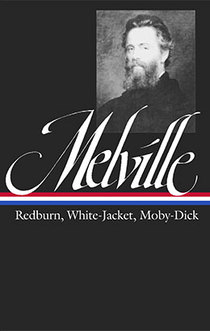
Herman MelvilleRedburn, White-Jacket, Moby-DickThe texts of Redburn, White-Jacket, and Moby-Dick presented in this volume are those of the Northwestern-Newberry Edition of The Writings of Herman Melville, edited by Harrison Hayford, Hershel Parker, and G. Thomas Tanselle and published by the Northwestern University Press and The Newberry Library (Redburn in 1969, White-Jacket in 1970, and Moby-Dick in 1988). Those texts were prepared according to the standards established by--and they have received the official approval of--the Center for Editions of American Authors of the Modern Language Association of America. (See its Statement of Editorial Principles and Procedures, revised edition, 1972.) The textual problems with which the Northwestern-Newberry editors have to deal increase in complexity from Redburn to White-Jacket to Moby-Dick, although the publication history of all three is essentially the same. In each case the American edition was set from manuscript and the English edition from proofs of the American. It was the English edition, however, that was actually published first. In the uncertain climate of international copyright in the nineteenth century, many English publishers of American works felt on stronger ground if their editions preceded the American editions. As a result, Redburn was published by Richard Bentley in London in early autumn 1849 in two volumes and by Harper & Brothers in New York in mid-November; White-Jacket was officially published in Bentley's two-volume London edition in late January 1850 and in the Harper edition in New York in March; and Moby-Dick appeared in Bentley's handsome three-volume edition, entitled The Whale and with whales on the spines, in mid-October 1851 and in the rather pedestrian Harper edition about a month later. The fact that the English editions came out first does not of course alter the fact that they are one step further removed from the manuscripts than are the American editions. Therefore the basic texts of these three works adopted by the Northwestern-Newberry editors are those of the American editions. Whenever there is a difference between the American and English texts and both readings seem to be authorial (as opposed to those situations in which one of the readings is clearly erroneous or is almost certainly the work of someone in the printer's or the publisher's office), the question arises as to which reading supersedes the other. Theoretically either could be the later one: Melville could have made alterations on the proofs for England that he had not made on the proofs for America; or he could have continued to read over the proofs for America, and make revisions on them, after furnishing one set of proofs to the English publisher. Redburn, however, provides almost no complications, for the relatively few differences between the American and English texts--with perhaps one exception (see the note on 271.10)--do not appear to result from authorial revision. This situation is not surprising, because Melville was occupied with the writing of White-Jacket at the time when he had to read the proofs for Redburn. The Northwestern-Newberry editors do correct some erroneous readings in the American text, but in most instances there is no reason to depart from it. In the case of White-Jacket, Melville had more time for revisions on the proofs for the English publisher, because he took those proofs with him when he sailed for London on October 11, 1849. He had received proofs at least a month earlier, and any alterations made before he sailed were presumably entered on the proofs for America as well as those for England. But he had three and a half weeks on shipboard to make additional changes for the English edition, as well as six weeks after he arrived in London, since he did not give the proofs to Bentley (according to his journal) until after December 18. The English edition does in fact exhibit a considerable number of differences from the American edition. One cannot automatically accept all of them as Melville's revisions, however, because some are certainly the result of changes made in Bentley's office. Others could be the earlier readings, revised by Melville for the American edition after he returned to the United States on February 1, 1850, roughly six weeks before American publication (though in general the American readings do not seem to be later). Unquestionably Melville's are seven additional passages in the English edition. They range from one to sixteen sentences and total more than seven hundred words, as well as eight additional phrases, clauses, and single words. All these are accepted by the Northwestern-Newberry editors, along with some other alterations that a publisher's reader would be unlikely to make (e.g., see the note on 372.39). The remaining differences, which range from simple oversights and indifferent substitutions to attempted grammatical or stylistic improvements and the softening of vigorous expressions, are not accepted; they are not clearly Melville's and do in fact correspond to the kinds of changes that Bentley's staff is known to have engaged in. (Bentley's use of a reader to expurgate or tone down forceful passages is established for Moby-Dick and therefore is a possibility for White-Jacket, and even if Melville made some alterations of this kind himself in anticipation of Bentley's reaction they would not represent his true intention; the notes for White-Jacket provide the English wording in a dozen or so instances of this kind.) Moby-Dick presents an editor with still more difficulties. Leaving aside many obvious errors and thousands of differences in punctuation, there are some six hundred differences in wording between the American and English editions. Melville again had considerable time to spend going over the proofs for England, but for different reasons this time. In the summer of 1851 he had the text set in type and plated on his own without waiting for arrangements to be concluded with an American publisher. His proofreading for the American plates was finished in late July, but he did not send a set of proofs to Bentley in England until September 10, two days before a contract with Harper & Brothers was signed for American publication. During those six weeks Melville would have been under no pressure to speed the proofs to England for prior publication there. No American publication was yet scheduled (indeed, the English contract did not arrive until late August or early September), and he had good reason for wanting to linger over the proofs and make further alterations, since at the time of his previous proofreading of the early part of the book he was still writing some of the later part and undoubtedly read those proofs more hurriedly than he would have otherwise. He was of course free to make as extensive alterations as he wished for England, because the text had to be reset there; but alterations made at this point could not be incorporated into the American text, already set and probably plated, without incurring additional expense. Under these circumstances the English text at points of variation is almost certainly later than the American. The problem is to try to distinguish the alterations for which Melville was responsible from those made in Bentley's office or at his direction. Like other Victorian publishers, Bentley employed readers who not only gave advice on submitted manuscripts but also revised accepted ones: Bentley told Melville the next spring, after seeing the manuscript of Pierre, that it would require alterations by a "judicious literary friend" in order to be "properly appreciated" in England. Some of the most striking differences between the two editions are easy enough to classify. The English edition omits thirty-eight passages of a sentence or more, totaling some 2,000 words; and the bulk of these changes, along with many smaller omissions or alterations, consist of expurgations of comments dealing with religion, sex, and politics. Anything that could remotely be regarded as sacrilegious, sexually explicit, or anti-British--including all of chapter 25--was eliminated or revised, thereby considerably altering the tone of the book. Obviously these changes are the work of Bentley's "judicious literary friend" (whom readers may wish to describe with a different adjective), and not of Melville. At the other extreme, it is equally clear that only Melville could have added the 140-word footnote on the term "galley" (1204.28-41) or inserted certain other words not required for sense ("out-hanging" in 803.4, "quick" in 932.31, "a doubloon" in 964.35, "embryo" in and 1345.30) In 1277.5, "sometimes," in 1326.13, "braced" in 1345.30). In between these extremes are the great majority of the differences, where the English variants could conceivably be either Melville's or the English editor's. It seems safe to say, however, that Melville was probably not responsible for the two hundred or so instances in which the English variant either produces a distinctly inferior reading. Although Melville could have made revisions that were not improvements, it is unlikely that he was responsible for the bulk of such a large number of changes that seem insensitive to the style of a passage (and are perhaps nothing more than typesetters' errors); and although he could have decided to "correct" his grammar at certain points, such a concern was not characteristic of him, whereas it is in line with what a publisher's reader would have been expected to think about. Furthermore, in nearly two hundred more variants the difference seems so slight that it is hard to see why anyone would have made the change (such as replacing "so long been" with "been so long", 817.39, or "our" with "the", 995.40; omitting "most", 1059.34; and adding "he", 1367.37). The conservative approach in such cases, given the doubt about whether Melville was responsible, is not to accept these changes as his. The two dozen additional points at which the English edition makes a statement more cautious or less colorful can generally be regarded as characteristic of Bentley's reader (such as altering "Louis the Devil" to "Louis Napoleon", 957.13, or "hangs for candelabra" to "is preserved", 1077.5), but occasionally a change of this kind occurs that is difficult to attribute to anyone except Melville (see the note on 958.37). The Northwestern-Newberry editors accept the few changes of this sort into the text, along with a final category of about three dozen alterations in which the English reading improves on the American so skillfully and thoughtfully that it is difficult to ascribe them to anyone other than Melville--such changes as "haply" for "happily" (853.6), "direst" for "direct" (949.16), "covertly" for "correctly" (1006.15), "modified" for "directed" (1022.5), "breath" for "life" (1137.25), "considerateness" for "considerations" (1236.16), "laving" for "leaving" (1379.36), and "death-grasp" for "death-gasp" (1407.14), or those commented on in the notes for 922.3, 962.7, 1084.3-4, and 1223.4. Melville by no means noticed all the discrepancies and incorrect words, however, and the Northwestern-Newberry editors correct about three dozen clearly erroneous readings that exist in both the American and English editions; but they do not alter certain others that could only be repaired through extensive rewriting (see the notes on 868.7, and 1281.6), and still others no doubt remain undetected. A particular problem is posed by Melville's liberal use of quotations from and paraphrases of other writers--a characteristic practice, noticeable in his previous books, that reaches its culmination here (most conspicuously in the eighty "extracts" prefacing the text, but in many other passages as well). The Northwestern-Newberry edition corrects such quotations or paraphrases by reference to the originals (or the editions Melville used, if known) only when the inaccuracy appears to be inadvertent. Whenever a good case can be made for Melville's intentional distortion of the original, no change is made. The first seven printings of this volume used the Northwestern-Newberry page proofs for the text of Moby-Dick. The present volume takes the text of Moby-Dick from the first printing of the Northwestern-Newberry edition, published in 1988, incorporating further decisions and emendations made by the editors of that edition. A much more detailed discussion of the differences between the American and English editions and of other editorial problems in Moby-Dick appears in the Northwestern-Newberry edition. The standards for American English continue to fluctuate and in some ways were conspicuously different in earlier periods from what they are now. In nineteenth-century writings, for example, a word might be spelled in more than one way, even in the same work, and such variations might be carried into print. Commas were sometimes used expressively to suggest the movements of voice, and capitals were sometimes meant to give significances to a word beyond those it might have in its uncapitalized form. Since modernization would remove such effects, this volume preserves the spelling, punctuation, capitalization, and wording of the Northwestern-Newberry edition, which strives to be as faithful to Melville's usage as surviving evidence permits. It also retains the original tables of contents despite their inconsistencies with the chapter headings found in the body of the texts.
Copyright 1995–2007 Literary Classics of the United States, Inc. |
|
List price: $40.00
Web store price: $32.00
Free shipping in the U.S.
Phone orders: 1-800-964-5778
Request product #200099
Subscription Account Holders: Buy the cream-slipcased edition at the
Customer Service Center.
ISBN: 978-0-94045009-7
1436 pages |