Flannery O'Connor Frank Norris Vladimir Nabokov John Muir Herman Melville Carson Mccullers James Madison H.P Lovecraft Henry Wadsworth Longfellow Jack London Abraham Lincoln Sinclair Lewis
American Literature by American Writers.
Sign up for E-Mail View CartMy Account
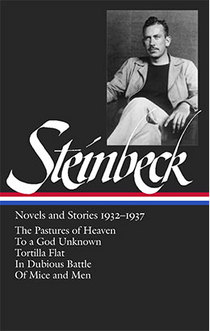
Steinbeck, John - Novels and Stories 1932–1937
Shopping & Subscriptions
News
Gifts & Donations
About LOA
Features
Home

John Steinbeck

Novels and Stories 1932–1937

The Pastures of Heaven (stories) • To a God Unknown • Tortilla Flat • In Dubious Battle • Of Mice and Men

 
John Steinbeck "was a born storyteller of vividly interesting tales. His capacity to bring alive realistic scenes and authentic speech was really quite exceptional."
—The New Criterion
 
Overview  |  Note on the Texts  |  Reviews  |  Table of Contents
 

This volume contains five early works by John Steinbeck, the linked short story collection The Pastures of Heaven (1932) and the novels To a God Unknown (1933), Tortilla Flat (1935), In Dubious Battle (1936), and Of Mice and Men (1937).

In May 1931, Steinbeck wrote to his friend Amasa Miller that he was at work on "a thing called The Pastures of Heaven . . . a series of related stories." In the same month he informed his agent, Mavis McIntosh of McIntosh & Otis, that the "manuscript is made up of stories, each one complete in itself, having its rise, climax and ending. Each story deals with a family or an individual. They are tied together only by the common locality and by the contact with Morans." (The Morans were the family on whom the Munroes of The Pastures of Heaven were modeled; Steinbeck wrote in his letter to McIntosh that "in their whole history I cannot find that they have committed a really malicious act . . . But about the Morans there was a flavor of evil. Everyone they came in contact with was injured. Every place they went dissension sprang up.") In the middle of December 1931 Steinbeck sent the completed manuscript to his agents, and it was accepted in the early spring of 1932 by Robert O. Ballou of Cape and Smith. Only weeks afterward, however, Cape and Smith went bankrupt, and Ballou moved to Brewer, Warren, and Putnam, where the book was accepted for publication. In October 1932 Brewer, Warren, and Putnam printed 2,500 copies; this firm, too, went bankrupt during the book's publication and left about 1,850 copies unbound. Ballou purchased the unbound sheets and unsold bound volumes and issued approximately 1,000 copies under his own imprint in late 1932. The remaining volumes and sheets were bought by Pascal Covici and issued under the Covici-Friede imprint in 1935. All three issues are therefore from the same printing, and the text of that printing is the one presented here. (In 1936, Covici-Friede published 370 copies of the sixth chapter separately, under the title Nothing So Monstrous. On this occasion, Steinbeck wrote a short epilogue that was not included in subsequent editions of The Pastures of Heaven; it is printed in the notes to this volume.)

To a God Unknown had its origins in "The Green Lady," a play written by Steinbeck's friend Webster (Toby) Street, who first showed Steinbeck his manuscript in 1927. Unable to complete the play, Street entrusted the manuscript to Steinbeck, who drafted part of a novel based on the play the following year, with authorial credit shared on the manuscript by Steinbeck and Street. Steinbeck continued to work on the book, making major alterations in the story. In the fall of 1931, at a time when he was also at work on The Pastures of Heaven, he described the novel as "torn down like a Duzenberg having its valves ground," and in February 1932 he wrote that he had "changed the place, characters, time, theme, and thesis." He sent the completed novel to McIntosh & Otis in February 1933, and it was published in the fall of 1933 by Robert O. Ballou under his own imprint. The remaining unbound sheets were later bought by Pascal Covici, who substituted a new title page and issued the book under the Covici-Friede imprint in the fall of 1935. Both these issues are therefore from the same printing, and the text of that printing is the one presented here. Steinbeck made no changes in the work subsequently.

Tortilla Flat was written fairly rapidly in the summer and fall of 1933. Robert O. Ballou had contracted to publish Steinbeck's next two books after The Pastures of Heaven but, concerned over the fragmentary form of the narrative, rejected the manuscript. Steinbeck then offered the book to Louis Kronenberger at Knopf, who had expressed interest in his work, but Kronenberger's response was also negative. Steinbeck's friend Mahlon Blaine subsequently showed the manuscript to a number of other New York publishers, all of whom rejected it. In late 1934, Steinbeck was contacted by Pascal Covici, who had been impressed by Steinbeck's work; Covici offered to publish Tortilla Flat, take an option on future books, and reissue Cup of Gold, The Pastures of Heaven, and To a God Unknown under the Covici-Friede imprint. Tortilla Flat was published in May 1935, in an edition of 4,000 copies. The book was Steinbeck's first popular success; there were at least eight printings between May 1935 and April 1937. In 1937, Steinbeck wrote a foreword for the Modern Library edition of Tortilla Flat, but he made no changes to the text. (The foreword is printed in the notes to this volume.) The text printed here is that of the first printing of the first edition.

In early 1934 Steinbeck met two labor organizers, Cicil McKiddy and Carl Williams, who were hiding out in Seaside, California, after participating in the San Joaquin Valley cotton strike of October 1933. He interviewed them with a view toward writing an account of the strike and of its leader, Pat Chambers, but was encouraged by Mavis McIntosh to recast the project as a novel. He began work on In Dubious Battle in early September 1934 and completed the first draft in five months; the novel was accepted by Pascal Covici and published by Covici-Friede in January 1936. No changes were made by Steinbeck in subsequent editions. The text printed here is that of the first edition.

The novel that eventually became Of Mice and Men was begun in January 1936, as a children's book. After several false starts, Steinbeck began serious work in March and, after suffering a setback when his dog tore up much of the manuscript in May, completed the book in mid-August 1936. It was published in February 1937 by Covici-Friede. In the first copies printed, the sentence that ends on page 798, line 10, of the present volume concluded with the words: "and only moved because the heavy hands were pendula." These words were removed and the entire page was reset, with the sentence now ending: "but hung loosely." The text printed here is that of the second state of the first edition, which contains this revision.

This volume presents the texts of the original printings chosen for inclusion here, but it does not attempt to reproduce features of their typographic design, such as display capitalization of chapter openings. The texts are printed without change, except for the correction of typographical errors. Spelling, punctuation, and capitalization are often expressive features, and they are not altered, even when inconsistent or irregular.

Copyright 1995–2007 Literary Classics of the United States, Inc.
Contact Us | Privacy and Security

LOA Web Store
List price: $35.00
Web store price: $31.50
ADD TO CART
Free shipping in the U.S.
Phone orders: 1-800-964-5778
Request product #200727
Subscription Account Holders: Buy the cream-slipcased edition at the Customer Service Center.
ISBN: 978-1-88301101-7
909 pages
More purchasing options
Amazon.com
Barnes and Noble
Powells.com
Other options

Get three Steinbeck volumes for only $9.95 as our way of introducing you to The Library of America.

Make a tax-deductible gift of volumes to a library of your choice.