H.P Lovecraft Henry Wadsworth Longfellow Jack London Abraham Lincoln Sinclair Lewis George S. Kaufman James Weldon Johnson Sarah Orne Jewett Thomas Jefferson William James Washington Irving Zora Neale Hurston
American Literature by American Writers.
Sign up for E-Mail View CartMy Account
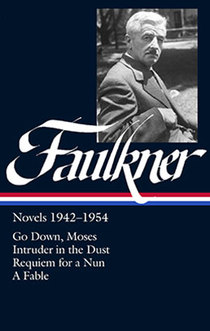
Faulkner, William - Novels 1942–1954
Shopping & Subscriptions
News
Gifts & Donations
About LOA
Features
Home

William Faulkner

Novels 1942–1954

Go Down, Moses • Intruder in the Dust • Requiem for a Nun • A Fable

 
"The Library of America's distinguished series has been tracing Faulkner's career by issuing his fiction in sets such as this one.... What we have here are four memorable works from what may well have been William Faulkner's most productive and provocative period."
—Bill Peschel, Rock Hill Herald
 
Overview  |  Note on the Texts  |  Reviews  |  Table of Contents
 

This volume prints the texts of Go Down, Moses, Intruder in the Dust, Requiem for a Nun, and A Fable that have been established by Noel Polk. All texts are based on Faulkner's own typescripts, the texts of which have been emended to account for his revisions in proofs, his typing errors, and certain other errors and inconsistencies that clearly demand correction. Underlying typescript and holograph drafts of these typescripts have been consulted regularly throughout the editorial process and have supplied the editor with numerous solutions to problems in Faulkner's final typescripts. By the time these novels were written, Faulkner composed almost exclusively at the typewriter rather than in longhand, which had been his practice up through the third book of The Hamlet (1940); although there are holograph drafts of extensive portions of Requiem for a Nun and of A Fable, most of the editorially significant preliminary materials for the novels in this volume are typescript.

Comparison has been made of all relevant extant forms of these works, published and unpublished, to determine the nature and causes of variants among the texts. The goal of these labors--to discover the forms of these works that Faulkner wanted in print at the time of their original publication--is sometimes elusive. Although thousands of pages of typescript and proof are available to the editor, it is not always clear what Faulkner's final intentions were, or even whether Faulkner had any "final" intentions regarding some of the individual components of his novels.

Copy-texts for all four of these novels are his own ribbon typescript copies (now on deposit at the Alderman Library of the University of Virginia), which were used by the typesetters of the first editions. Faulkner seems to have typed most of these pages himself (clearly some pages of A Fable and Requiem for a Nun have been typed by somebody else), with different degrees of care; these pages contain both authorial and editorial alterations of varying extent and seriousness. Faulkner was in some ways an extremely consistent writer. He never included apostrophes in the words "dont", "wont", "aint", "cant", or "oclock", and very seldom used an apostrophe to indicate a dropped letter in a spoken dialect word, such as "bout" or "runnin". He never used a period after the titles "Mr", "Mrs", or "Dr". The editors of the first editions generally, but inconsistently, accepted these practices, but compositors often made mistakes, and many periods and apostrophes slipped in. More serious problems also frequently occurred, mostly attendant upon editors' and Faulkner's indifferent proofreading and upon editors' general lack of understanding of what Faulkner was trying to do. Although the editors for these novels did not make the kinds of wholesale alterations that were made in the editing of Absalom, Absalom!, for example, or alterations as significant as changing the title of If I Forget Thee, Jerusalem to The Wild Palms, they did intervene in hundreds of ways that affected the texts of the novels being published. In Requiem for a Nun, for instance, Faulkner wrote in one elegiac passage of the effect on Jefferson Negroes of their hangovers after "Juneteenth," a portmanteau word commemorating June nineteenth, the date of emancipation in Texas; the Random House editor, not knowing this, changed "Juneteenth" to "June tenth," in the context a usage not just completely meaningless, but likely to be confusing as well. Likewise, in order to show the unbroken continuity between the prologues and the dramatic portions of Requiem for a Nun, Faulkner went to the trouble, at a late stage of composition, to ink out the first two lines of Act I, Scene I, at the top of typescript page 50, and then to retype a version of those lines at the end of the text of the prologue on typescript page 49: his intention is absolutely clear from the evidence of the typescript, but the editor nevertheless directed the printer to start Scene I on a new page. Curiously, the texts of Go Down, Moses and Intruder in the Dust, novels published in the 1940s, are mostly marked by editorial indifference, and the problems are mostly typographical errors, things that should have been caught by a careful proofreader; the texts of Requiem for a Nun and A Fable, on the other hand, Faulkner's first two novels after he won the Nobel Prize in 1950, were much more seriously treated by the original editors, though often with cumulatively worse results.

Faulkner's attitude toward such intervention is neither consistent nor entirely clear. Almost from the beginning of his career, he was a supremely confident craftsman; he was at the same time aware of the complexity of the demands his work would make not merely on the reader but also on the publisher, editor, and proofreader. His response, early in his major career, to Ben Wasson's tampering with the Benjy section of The Sound and the Fury--that he would rewrite it if publishing were not grown up enough to publish it as he wanted it--reflects both his flexibility toward the realities of publication and his impatience with those mechanical processes of publication beyond his control that might thwart the accomplishment of his artistic goals. He seems to have been indifferent to some types of editorial changes, and he acquiesced to them; he seems not to have cared whether certain words were spelled consistently or not, whether certain of his archaisms were modernized or not, and he seems to have expected his editor to divine from his typescript whether each sentence was punctuated exactly as he wanted it--that is, whether or not a variation from an apparent pattern was in fact a deliberate variation or merely an inadvertency he expected an editor to correct. Thus while some of his marks on galley and page proofs were genuine revisions of his own, many others were clearly attempts to repair damage of one sort or another made by someone else on the typescript setting copy.

With the benefit of decades of intense scholarship, we are now perhaps in a better position to understand Faulkner's intentions, although clearly many of the original editorial problems remain. The Polk texts attempt to reproduce the texts of Faulkner's typescripts as he intended them to be originally published, in so far as that intention can be reconstructed from the evidence. For the most part, only those revisions on typescript or in proof that Faulkner seems to have initiated himself in response to his own text are accepted, and not those he made in response to a revision or a correction suggested or inserted by an editor; this is a very conservative policy that may reject some of Faulkner's proof revisions in favor of his original text. Polk's interventions, then, strive to be minimal, and every effort has been made to preserve Faulkner's idiosyncracies in spelling and punctuation. Nevertheless, certain corrections of unmistakable typing errors and other demonstrable errors in the typescripts have been necessary.

Go Down, Moses is made up of a group of short stories that Faulkner had been writing over a period of several years, and whose relationships with one another he discovered some time around 1940. The book was published on May 11, 1942, under the title Go Down, Moses and Other Stories. The editors added "and Other Stories" to the title page, and Faulkner asked them to remove it in 1949 when they proposed to reprint the book in the wake of the success of Intruder in the Dust; he wrote to Robert Haas of Random House: "Moses is indeed a novel. . . . Indeed, if you will permit me to say so at this late date, nobody but Random House seemed to labor under the impression that GO DOWN, MOSES should be titled 'and other stories.' I remember the shock (mild) I got when I saw the printed title page. I say, reprint it, call it simply GO DOWN, MOSES, which was the way I sent it in to you 8 years ago."

Go Down, Moses has its general origins in the early 1930s in such short stories as "Red Leaves" and "A Justice," in which Faulkner introduced characters like Issetibbeha and Ikkemotubbe, Mississippi Indians who became land-traders and slave-owners. The novel's specific origins are in a 1935 short story, "Lion," about a dog who tracked a bear. The central character of "Lion," however, is not Isaac McCaslin, but Quentin Compson, who had committed suicide in The Sound and the Fury (1929), and whom Faulkner was resurrecting, at the same time he was writing "Lion," for his role in Absalom, Absalom! (1936).

In late 1939 Faulkner began writing other stories which he eventually revised and incorporated into Go Down, Moses. On October 3 he sent "The Old People," the story of Isaac McCaslin's initiation, to his agent, Harold Ober (it was published in Harper's, September 1940). By February 23, 1940, he had completed all three of the stories that he later incorporated into "The Fire and the Hearth," the story of Carothers McCaslin's black descendant, Lucas Beauchamp: "Point of Law" (Collier's, June 1940), "Gold Is Not Always" (American Mercury, November 1940), and "An Absolution," which was not published in a periodical. On March 18, 1940, he sent Ober the typescript of "Pantaloon in Black" (Harper's, October 1940) and on July 24 he sent Ober "Go Down, Moses" (Collier's, January 25, 1941), which became the final chapter of the new work, thus completing the materials about the black inheritors of Old Carothers' legacies.

In April 1940 Faulkner wrote to Random House asking for an advance so that he could write two novels, one a "blood and thunder mystery novel" (which would become Intruder in the Dust in 1948), and another novel "in method similar to The Unvanquished." By July I, 1940, he had completed "Almost," an early version of "Was," which remained unpublished until its inclusion in the novel. He sent "Delta Autumn" (Story, May-June 1942) to Ober on December 16, 1940. Throughout this period, Faulkner was also apparently working to revise the 1935 story "Lion" into the long and complicated chapter that eventually became "The Bear," though it was still called "Lion" on the typescript he submitted to Random House. In the fall of 1941, needing money as usual, he reduced the narrative materials of "Lion" to a 20-page version (published in The Saturday Evening Post, May 4, 1942).

Faulkner then carefully revised each story and sent to Random House a completely revised and retyped typescript, which the editors pushed through to publication with a minimum of intervention that amounted to virtual indifference. They often overlooked problematic passages--like at least one entire line that Faulkner failed to type from a previous version, now lost--that needed editorial query. The typescript submitted by Faulkner is the copy-text for the Polk text.

The years following the publication of Go Down, Moses were difficult for Faulkner: he had trouble selling stories to magazines, he got enmeshed in a restrictive contract with a Hollywood agent and movie studio, and he began to write A Fable (on which he would work for the next eleven years), taking time out to write "The Compson Appendix" (1946). In increasing financial straits, he put aside work on A Fable on January I5, 1948, and began work on the book he had described to Random House nearly seven years earlier, in June 1940, as "a mystery story, original in that the solver is a negro, himself in jail for the murder and is about to be lynched, solves murder in self-defense." He worked very fast and wrote to Robert Haas of Random House on February 22 that he had finished the first draft and was rewriting. By April 27 he had sent the completed work to Random House, and uncharacteristically asked his publishers for help in choosing a title. Faulkner wrote that he wanted "a word, a dignified (or more dignified) synonym for 'shenanigan['], 'skulduggery[']; maybe a legal-quasi-latin word, for title like this" and he proposed Shenanigan, Skulduggery, and Jugglery, all to be combined with "in the Dust." Haas responded with several other suggestions, all likewise to be combined with "in the Dust": Imposture, Masquerade, Stratagem, Pattern, and Cabal. Faulkner counterproposed Imposter, Intruder, Sleeper, Malfeasance, Substitution, Malaprop, Malpractice and Trouble. He seems to have settled on "Intruder" by early May. Intruder in the Dust was published by Random House on September 27, 1948. Faulkner's typescript is the copy-text for the Polk text.

Faulkner first used the title Requiem for a Nun in a letter to his publisher, Harrison Smith, in October 1933, telling him that he had "another bee now, and a good title, I think: REQUIEM FOR A NUN. It will be about a nigger woman. It will be a little on the esoteric side, like I LAY DYING." In December 1933 Faulkner wrote at least three manuscript pages (two different versions of an opening) of a work by that title, though these pages provide inconclusive evidence about whether it was to be a sequel to Sanctuary or whether it bears any other relationship to the 1951 novel.

On February 11, 1949, Faulkner began writing Requiem for a Nun as a play for his friend Ruth Ford, who had asked him to write a play for her and whose "terrifying determination to be an actress" he had long admired. By this time he had also met an aspiring young writer named Joan Williams, whom he proposed to make a protưgư by getting her to collaborate with him. By May 19, 1950, he had reconceived the work as a novel in three acts, each act preceded by a long prose narrative recounting the history of Yoknapatawpha County and Mississippi. He completed the novel by June 1, 1951, and it was in galleys by June 13.

At Faulkner's instructions, Robert Linscott of Random House sent a set of galleys to Ruth Ford. During the summer of 1951, Faulkner, Ford, and director Albert Marre met in New York and in Cambridge, Massachusetts, to adapt the novel to the stage. As Faulkner worked on the stage version, he made extensive revisions to the galleys of the novel, returning them to Random House with numerous attached carbon typescript sheets containing text that was to replace the text as originally submitted. Thus copy-text for the Polk text of Requiem for a Nun is a combination of Faulkner's original typescript and these new sheets from the play script, as they revised the galleys. Requiem for a Nun was published on September 7, 1951, in a text marred by a large number of typographical errors and several unfortunate editorial alterations. (The stage version, credited to Faulkner and Ruth Ford, was published by Random House in 1959.)

A Fable was conceived in 1943 during a discussion in wartime Hollywood among Faulkner, producer William Bacher, and director Henry Hathaway about a film on the Unknown Soldier. One proposal was that the Unknown Soldier might have been Jesus Christ returned to earth to give humanity one last chance, an idea Faulkner was enthusiastic about. They never made a film on this theme, but the basic idea was to consume Faulkner for over a decade, with brief stints away from it to work on filmscripts, "The Compson Appendix," Intruder in the Dust, the stories that would make up Knight's Gambit, and Requiem for a Nun. There exist several hundred pages of preliminary typescript and manuscript, some of it dated as early as 1947, and the typescript setting copy is itself composed of typescript pages from several different versions of various passages, typed on at least two different typewriters and clearly representing materials dating from throughout the decade of its composition. Faulkner took the typescript of A Fable to Random House on November 5, 1953, and soon after left for four months in Europe, where he visited friends and worked on a film for Howard Hawks. While reading proof in Rome in April 1954, he wired Random House that he had forgotten to include the "Judas Misery" material in the chapter titled "Tomorrow," and he supplied that material when he returned to New York. Random House published the book on August 2, 1954, in a text altered in hundreds of major and minor ways by editorial intervention. Faulkner's typescript is the setting copy for the Polk text reproduced here, except for the "Judas Misery" sequence, for which the first edition is the only extant text.

By preserving his spelling, punctuation, and wording, even when inconsistent or irregular, the Polk texts strive to be as faithful to Faulkner's usage as surviving evidence permits. In this volume, the reader has the results of the most detailed scholarly efforts thus far made to establish the texts of Go Down, Moses, lntruder in the Dust, Requiem for a Nun, and A Fable.

Copyright 1995–2007 Literary Classics of the United States, Inc.
Contact Us | Privacy and Security

LOA Web Store
List price: $40.00
Web store price: $32.00
ADD TO CART
Free shipping in the U.S.
Phone orders: 1-800-964-5778
Request product #200735
Subscription Account Holders: Buy the cream-slipcased edition at the Customer Service Center.
ISBN: 978-0-94045085-1
1115 pages
More purchasing options
Amazon.com
Barnes and Noble
Powells.com
Other options

Make a tax-deductible gift of volumes to a library of your choice.