|
||||||||||||||||
|
|
|
|
|
|
|
|
|
|
|
|
|
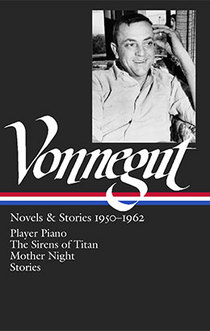
Kurt VonnegutNovels & Stories 1950–1962Player Piano • The Sirens of Titan • Mother Night • stories
Together in one volume, Kurt Vonnegut’s first three brilliant novels, along with six classic science fiction stories
Read an interview with volume editor Sidney Offit on Reader's Almanac, the Library of America blog Kurt Vonnegut’s signature qualities as a writer—what John Updike called “his free flow of invention, the surreal beauty of his imagery, and a colloquial American style justly ranked with Mark Twain’s”—are everywhere on display in this authoritative collection of his early fiction. So too are his abiding themes: the madness of war, the vanity of human striving, and the social costs of technological innovation. Vonnegut’s first novel, Player Piano (1952), is the story of Dr. Paul Proteus, chief engineer at the Ilium Works, an electronics company in upstate New York. Ill at ease with himself and his changing times, Proteus must choose sides in a looming civil war that threatens the brave new world he has helped to create. A kind of postwar Metropolis, Player Piano is at once a witty satire on the culture of General Electric headquarters, where Vonnegut once worked as a publicist, and a profound meditation on the dignity and necessity of work. Set on Earth, Mars, Mercury, and the moons of Saturn, The Sirens of Titan (1959) is a vertiginous ride down a funnel in space-time with a trio of stuffed shirts spoiling for their pratfalls: Winston Niles Rumfoord, a patrician New Englander and paragon of style; his beautiful touch-me-not wife, Beatrice; and Malachi Constant, the world’s luckiest, wealthiest man. Are they really what they imagine themselves to be, the perfected products of a benevolent universe? Or does somebody up there despise them? Only Salo, the gentleman-robot from the planet Tralfamadore, knows for sure. In 1961 a German American named Howard W. Campbell, Jr.—the Tokyo Rose of the Third Reich—is discovered in Manhattan by a team of Nazi hunters and brought to Jerusalem to stand trial. Mother Night (1962) presents Campbell’s prison-cell confessions, revealing him to be a double agent who infiltrated the highest echelons of the Nazi propaganda ministry in order to broadcast intelligence to the Allies. But as he awaits his date with justice, Campbell faces an even more rigorous trial in the court of his own conscience. Rounding out the volume are six of Vonnegut’s best science fiction stories, including “Report on the Barnhouse Effect,” “EPICAC,” “Tomorrow and Tomorrow and Tomorrow,” and “Harrison Bergeron,” the fantasy that skewered “political correctness” before there was a name for it. Sidney Offit, editor, has written novels, books for young readers, and memoirs including, most recently, Friends, Writers, and Other Countrymen. He was senior editor of Intellectual Digest, book editor of Politics Today, and contributing editor of Baseball Magazine. He wrote the foreword to Look at the Birdie, a collection of Kurt Vonnegut’s unpublished short fiction. Also by Kurt Vonnegut: Also of Interest:
Copyright 1995–2011 Literary Classics of the United States, Inc. |
|
List price: $35.00
Web store price: $31.50
Free shipping in the U.S.
Phone orders: 1-800-964-5778
Request product #202418
Subscription Account Holders: Buy the cream-slipcased edition at the
Customer Service Center.
Booksellers/Libraries: LOA books are distributed worldwide by the Penguin Group.
ISBN: 978-1-59853-150-3
834 pages |