|
||||||||||||||||
|
|
|
|
|
|
|
|
|
|
|
|
|
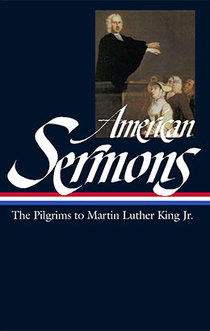
American Sermons: The Pilgrims to Martin Luther King Jr.
"[T}aken as a whole, the sermon form is revealed to have remarkable literary vitality. Influenced by the Bible, tinged by African and evangelical cadences, the sermons constitute a very American idiom. One can read these as historical artifacts, which they are. I found them satisfying as literature."
— The New York Times The sermon is the first and most enduring genre of our literature. The fifty-eight sermons collected in this Library of America volume display the form's eloquence, intellectual rigor, and spiritual fervor, Ranging from the first New England settlement to mass-media evangelism and the Civil Rights movement in the 1960s. Public and private, radical and conservative, learned and vernacular, famous and obscure, these texts reclaim a neglected form of American literary art. The sermons of the Puritan tradition are extraordinary in their richness of imagery, force of argument, and probing psychological insights. From John Winthrop's visionary injunction that "wee must consider that wee shall be as a Citty upon a Hill, " to Samuel Danforth's admonition not to deviate from the divine "errand into the wilderness," the early sermons first explored what it means to be an American. Jonathan Edwards's remarkable "Sinners in the Hands of an Angry God," which stirred its 18th-century audiences to frenzy, shows the intensity to which the sermon could rise, while Jonathan Mayhew's "Discourse Concerning Unlimited Submission" heralds the political thinking that led to the American Revolution. The ferment of the 19th century—the Mexican War, the struggle against slavery, the Civil War—inevitably affected the sermon. Orthodoxies were challenged, and a new diversity emerged in the Unitarianism of William Ellery Channing, the Transcendentalism of Ralph Waldo Emerson, the new Church of Latter Day Saints, and the gathering strength of the African-American sermon tradition. The 20th-century sermons collected here continue to wrestle with fundamental spiritual and civic concerns. They range from a homily on charity by the popular evangelist Billy Sunday to a discourse on interfaith cooperation by Abraham Joshua Heschel, and from Harry Emerson Fosdick's controversial "Shall the Fundamentalists Win?" to John Gresham Machen's uncompromising riposte. The achievement of the African-American sermon attains a new breadth of influence in the inspiring oratory of Martin Luther King Jr. Michael Warner, volume editor, is professor of English and American Studies at Yale University and author of The Letters of the Republic: Publication and Public Sphere in Eighteenth Century America.
Also Available:
Copyright 1995–2007 Literary Classics of the United States, Inc. |
|
List price: $40.00
Web store price: $32.00
Free shipping in the U.S.
Phone orders: 1-800-964-5778
Request product #201113
Subscription Account Holders: Buy the cream-slipcased edition at the
Customer Service Center.
ISBN: 978-1-88301165-9
939 pages |