|
||||||||||||||||
|
|
|
|
|
|
|
|
|
|
|
|
|
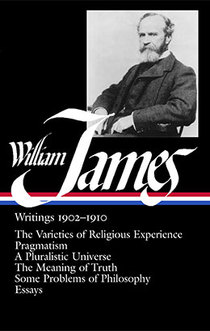
William JamesWritings 1902–1910The Varieties of Religious Experience • Pragmatism • A Pluralistic Universe • The Meaning of Truth • Some Problems of Philosophy • Essays
"...James was incapable of observing a distinction between the scientist's 'facts' and the philosopher's 'values.' He thought that every choice we make, including the choice to be 'scientific' and 'objective,' originates in feeling, and is therefore a moral choice."
—Newsday This volume includes the following works by William James published between 1902 and 1911: The Varieties of Religious Experience: A Study in Human Nature. Being the Gifford Lectures on Natural Religion Delivered at Edinburgh in 1901-1902; Pragmatism: A New Name for Some Old Ways of Thinking. Popular Lectures on Philosophy; A Pluralistic Universe. Hibbert Lectures at Manchester College on the Present Situation in Philosophy; The Meaning of Truth: A Sequel to 'Pragmatism'; Some Problems of Philosophy: A Beginning of an Introduction to Philosophy; and a selection of twenty short pieces written during that period. When James first accepted the offer of the Gifford Lectureship early in 1898, the lectures that make up The Varieties of Religious Experience: A Study in Human Nature were scheduled to be delivered in two courses of ten each at the University of Edinburgh during the winters of 1899-1900 and 1900-01. By the time James sailed for Europe in July 1899, the date of delivery for the first course had been changed to the late spring of 1900. Pressure of work and then his developing heart problems had prevented him from working on the lectures earlier, but he hoped that treatment at the spa at Bad Nauheim would give him the strength to write again. His health continued to fail, and in December 1899 he resigned the lectureship. The Gifford committee refused his resignation, however, and on May 16, 1901, after repeated postponements and continued severe illness, James delivered his first lecture. The course was very successful, and by the time he gave the last lecture on June 17 his health had improved. He returned home to Cambridge in September and soon began work on the second course of ten lectures. The writing this time proceeded smoothly, and that fall he also began to have the lectures set in type at H. O. Houghton's Riverside Press in Cambridge for publication in New York and London by Longmans, Green, and Co. in June 1902. By late March he had finished the index and corrected the proofs. The second course of lectures was delivered in Edinburgh from May 13 to June 9, 1902, and before the lectures were finished he received the first copy of the completed book. It was immediately successful, and new printings were made from the plates in August, October, November, and December 1902; January, March, and November 1903; April and September 1904; February 1905; February and November 1906; May 1907; February and September 1908; August 1909; and June and October 1910. The thirty-eighth printing in 1935 was the last to be made from these plates. James's annotated copy of the first printing, in the Houghton Library at Harvard University, records corrections and revisions he wanted to make in the text. Only about half were made in later printings, and a few of these had to be slightly altered to fit existing lines. Omitting or adding words, unless at the end of a paragraph, could be complicated and expensive. For example, at 74.7-9, James wanted to revise "and our articulately verbalized philosophy is but its showy translation into formulas. The unreasoned and immediate assurance is the deep thing in us, the reasoned argument is but a surface exhibition" by omitting the italicized words and inserting "verbalized" after "showy." Since dropping six words would have involved considerable cutting of the plates and would have affected more than one page, the change was not made. Though not marked in his copy, James also corrected the footnote on page 115 and added quotation marks to the case studies on pages 117-20; apparently some early readers assumed that the case studies were from James's own experience, and a correction slip was inserted into some copies of the first printing and the corrections made in the second. The present volume prints the text of William James's annotated copy of the first printing of the first edition, Harvard *AC85.J2376.902v(c), incorporating all the corrections and revisions he marked in it, as well as the alterations noted on pages 115 and 117-20. Pragmatism: A New Name for Some Old Ways of Thinking evolved from a series of lectures James began in 1905. The first three courses of lectures were delivered from notes: five lectures at Wellesley College, February 28 to March 10, 1905; five lectures at the University of Chicago, June 30 to July 7, 1905; and a series of lectures at Glenmore in Keene, New York, July 28 to August 3, 1905. In preparation for eight lectures to be given at the Lowell Institute in Boston from November 14 to December 8, 1906, James began the actual writing that would become the book, and he was still writing the later lectures after he began delivering the first ones. The lectures were repeated to large audiences at Columbia University from January 29 to February 8, 1907, and James continued to make revisions in them. Three of the lectures, I, II, and VI, were prepared for periodical publication during this time, but with the stipulation that they not be published until after his appearance at Columbia. Lecture I, "The Present Dilemma in Philosophy," appeared under the title "A Defence of Pragmatism: I. Its Mediating Office" in Popular Science Monthly for March 1907; Lecture II, "What Pragmatism Means," under the title "A Defence of Pragmatism: II. What Pragmatism Means" in Popular Science Monthly for April 1907; and Lecture VI, "Pragmatism's Conception of Truth," in The Journal of Philosophy, Psychology and Scientific Methods for March 14, 1907. James revised these three lectures directly on the journal offprints and eventually submitted them in that form for book publication. A fourth article, used as the basis for Lecture III, "Some Metaphysical Problems Pragmatically Considered," had been published earlier under the title "The Pragmatic Method" in The Journal of Philosophy, Psychology and Scientific Methods for December 9, 1904; this revision in turn had been a revision of "Philosophical Conceptions and Practical Results," in The University of California Chronicle for September 1898, reprinted for the Philosophical Union of the University of California (Berkeley: The University Press, 1898). This article was also prepared for book publication by revising journal pages that were supplemented by newly prepared manuscript. The remaining four lectures were submitted in heavily revised manuscript. James took the manuscript to the printer, H. O. Houghton's Riverside Press in Cambridge, in March 1907. The book was published in New York and London by Longmans, Green, and Co. from sheets printed at the Riverside Press in June 1907. Pragmatism went through eight further printings during James's lifetime: July (twice), October and November 1907; February and September 1908; March 1909; and April 1910. In his own copy of the first printing, now at the Houghton Library at Harvard, James marked seventy-eight changes to be made by the printer, but only six of these were made in the plates during the successive reprintings, and one of the changes, the correcting of the spelling of "Vivekanda" to "Vivekananda" at 552.22, also necessitated a change of the word "shores" to "land" to make room in the line. The spelling of "Vivekananda" was also corrected in two other places and in the index, though James did not mark them in his own copy; slight alterations in James's wording were again necessary to make room for the additional syllable. No other corrections were made. The present volume prints the text of James's own corrected copy of the first printing of the first edition of Pragmatism, Harvard *AC85.J2376.907p(c), and includes all the revisions and corrections he marked in it. On November 29, 1907, James accepted an offer to give a course of eight Hibbert Lectures at Manchester College in Oxford in the spring of 1908 and immediately set to work. By the time he sailed for England in April 1908 he had written almost all of the lectures that were to become A Pluralistic Universe. He left the bulk of the manuscript to be set at H. O. Houghton's Riverside Press. Proof was sent to him for correction while he was still at Oxford. The first lecture was delivered May 4 and the last May 28, 1908, attracting audiences larger than those of any previous lecturer on philosophy at Oxford. During the rest of the summer he continued to correct proof sent to him by the Riverside Press. He also prepared four of the lectures for successive publication in The Hibbert Journal, condensing and omitting some material, as well as cutting introductory remarks and other forms of direct address to the audience in order to shorten the pieces to fit the Journal format. Lecture VIII, "Conclusions," appeared as "Pluralism and Religion" (July 1908); Lecture III as "Hegel and His Method" (October 1908); Lecture IV "Concerning Fechner," as "The Doctrine of the Earth-Soul and of Beings Intermediate Between Man and God. An Account of the Philosophy of G. T. Fechner" (January 1909); and Lecture VI, "Bergson and His Critique of Intellectualism," as "The Philosophy of Bergson" (April 1909). On his return to Cambridge, he repeated the lectures at Harvard, beginning November 6 and ending November 30, 1908. Three appendices were added to the lectures for book publication. Two were slightly revised versions of earlier articles: Appendix A, "The Thing and Its Relations," had appeared in The Journal of Philosophy, Psychology and Scientific Methods for January 19, 1905; and Appendix B, "The Experience of Activity," in The Psychological Review for January 1905. The third, "On the Notion of Reality as Changing," appeared for the first time as Appendix C in A Pluralistic Universe. James continued to make revisions even after the book was already in type. Apparently when he first gave the manuscript to Houghton for setting, it did not include the notes, because--in contrast to the form of his other books--the notes in the first edition of A Pluralistic Universe are in a section by themselves following the lectures and before the appendices. The book was published April 1909 in New York and London by Longmans, Green, and Co. Sheets printed by the Riverside Press in Cambridge were used for both American and English publication. A second printing (with unaltered text) was made in August 1909, but a third printing was not called for until March 1912, and there were far fewer printings of A Pluralistic Universe than there had been of The Varieties of Religious Experience or Pragmatism. The text of James's own corrected copy of the first printing of the first edition at the Houghton Library, Harvard University (WJ 200.25.3), including the twelve corrections and revisions he marked in it, is printed in the present volume. Each note has been placed at the foot of the page containing the passage referred to, following the form of the other books. Soon after finishing work on A Pluralistic Universe James began assembling and revising a group of previously published journal essays for inclusion in The Meaning of Truth: A Sequel to 'Pragmatism.' His own notes to the first eight chapters and Chapter XII identify the original appearances of these nine essays. Chapter XI, "The Absolute and the Strenuous Life," appeared in The Journal of Philosophy, Psychology and Scientific Methods, September 26, 1907 (not 1906 as in James's footnote). Chapter IX, "The Meaning of the Word Truth," was revised either from the privately printed pamphlet or from the version printed in Mind, July 1908. Chapter X, "The Existence of Julius Cısar," was printed in The Journal of Philosophy, Psychology and Scientific Methods, March 26, 1908. Chapter XIII, "Abstractionism and 'Relativismus,' " originally appeared in Popular Science Monthly, May 1909. James added transitional sentences and paragraphs to the original articles, extracted parts of others, and reworked phrases and punctuation. The Preface, Chapter XIV, "Two English Critics," and Chapter XV, "A Dialogue," were written for the volume. No index was prepared for this work. The manuscript was delivered by James to the Riverside Press in Cambridge April 7, 1909. The Meaning of Truth was published in New York and London by Longmans, Green, and Co. in October 1909. Sheets from the Riverside Press were again used for both American and English publication. Second and third printings followed in November, and a fourth printing appeared in January 1911. James's own copy of the first printing contains a list of six corrections and revisions he wanted to make: one of them was made in the second printing and four others in the third. The printer also made one unauthorized change: James wanted to emend "anything else I am aware of" to "anything else of which I am aware" (963.33), but the printer, to make this revision fit, shortened it to "anything of which I am aware." The present volume prints the text of James's private copy of the first printing of the first edition, Harvard *AC85.J2376.909m(b), and incorporates the six changes that James wanted made. James did not live to see Some Problems of Philosophy into print. His written instructions for publishing the book noted that "it is fragmentary and unrevised. . . . Say that I hoped by it to round out my system, which now is too much like an arch built only on one side." Before his death he appointed Horace M. Kallen to see it through the press. Kallen was aided by William James's son Henry and Ralph Barton Perry. The book was set and printed at the Riverside Press in Cambridge and was published in New York and London by Longmans, Green, and Co. in May 1911. This volume presents the text of the first printing of the first edition. The twenty short pieces included in the present volume are a selection from the years 1903-10. The texts printed here are those of the original periodical appearances (except "Answers to a Questionnaire," which was published in The Letters of William James), and they incorporate the few corrections made by James in his private file copies (identified in parentheses below) now in the James collection at the Houghton Library at Harvard University:
"The Ph.D. Octopus," The Harvard Monthly, March 1903, pp. 1-9. (*80-55) This volume is concerned with presenting the texts described here; it does not attempt to reproduce features of the typographic design of the original printings, such as the display capitalization of chapter openings. The original indexes for The Varieties of Religious Experience, Pragmatism, A Pluralistic Universe, and Some Problems of Philosophy are reproduced here, corrected only to correspond to corrections or emendations made in the texts of those editions. Two indexes are newly supplied: one for The Meaning of Truth (which appeared without one), and the other for the Essays section. Whenever James refers to book-length works included in the present volume, his page citations are changed to the corresponding pages here. His page citations referring to periodical publications, however, have not been replaced, even when the particular article is included here, since to do so would involve more extensive changes. In such instances, page references to the present volume are provided in the notes. The texts selected for printing in this volume are reproduced without other changes except for the correction of typographical errors. Spelling, punctuation, and capitalization often are expressive features, and they are not altered even when apparently inconsistent or irregular. James, for example, will sometimes use a shortened form of a word (such as "tho") and yet occasionally will also use the full form ("though").
Copyright 1995–2007 Literary Classics of the United States, Inc. |
|
List price: $45.00
Web store price: $32.00
Free shipping in the U.S.
Phone orders: 1-800-964-5778
Request product #200388
Subscription Account Holders: Buy the cream-slipcased edition at the
Customer Service Center.
ISBN: 978-0-94045038-7
1379 pages |