Zore Neale Hurston William Dean Howells Nathaniel Hawthorne Dashiell Hammett Alexander Hamilton Ulysses S Grant Robert Frost Benjamin Franklin Scott F Fitzgerald William Faulker James T Farrell
American Literature by American Writers.
Sign up for E-Mail View CartMy Account
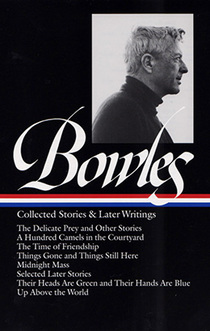
Bowles, Paul - Collected Stories and Later Writings
Shopping & Subscriptions
News
Gifts & Donations
About LOA
Features
Home

Paul Bowles

Collected Stories and Later Writings

The Delicate Prey • A Hundred Camels in the Courtyard • The Time of Friendship • Things Gone and Things Still Here • Midnight Mass • The Heads are Green and Their Hands are Blue • Up Above the World • selected later stories

 
"The Library of America has made it easier for readers to enjoy Bowles's exotic literary harvest."
— The Columbus Dispatch
 
Overview  |  Note on the Texts  |  Reviews  |  Table of Contents
 

This volume contains the 52 short stories by Paul Bowles that appeared in the collections The Delicate Prey and Other Stories (1950), A Hundred Camels in the Courtyard (1962), The Time of Friendship (1967), Things Gone and Things Still Here (1987), and Midnight Mass (1981; expanded edition 1983); six stories published between 1983 and 1990; the travel essays collected in Their Heads Are Green and Their Hands Are Blue (1963); and the novel Up Above the World (1966). The texts of these works are generally taken from their first book publications, because Bowles did not significantly revise these works after they appeared in book form; for The Delicate Prey and Other Stories and Their Heads Are Green and Their Hands Are Blue, the first American editions have been preferred over English editions published a few months earlier because these English editions incorporate changes based on British conventions. The English version of The Delicate Prey and Other Stories, entitled A Little Stone, also omitted material because of censorship concerns.

The Delicate Prey and Other Stories comprises 17 stories written between 1939 and 1949. Bowles wrote "Tea on the Mountain" in 1939, during a period of his career when he was otherwise composing music; the remaining stories were written between 1945 and 1949. He recalled in an interview that reading and suggesting revisions to Jane Bowles' Two Serious Ladies in 1941 "excited" him and made him want to write his own fiction; but according to his autobiography, Without Stopping (1972), it was not until 1945, after reading "some ethnographic books with texts from the Arapesh or from the Tarahumara," that he "crept back into the land of fiction writing." Bowles goes on to say: "Little by little the desire came to me to invent my own myths, adopting the point of view of the primitive mind. The only way I could devise for simulating that state was the old Surrealist method of abandoning conscious control and writing whatever words came from the pen. First, animal legends resulted from the experiments and then tales of animals disguised as 'basic human' beings. One rainy Sunday I awoke late, put a thermos of coffee by my bedside, and began to write another of these myths. No one disturbed me, and I wrote on until I had finished it. I read it over, called it 'The Scorpion,' and decided that it could be shown to others. When View published it, I received compliments and went on inventing myths. The subject matter of the myths soon turned from 'primitive' to contemporary, but the objectives and behavior of the protagonists remained the same as in the beast legends." Bowles began publishing stories in magazines in 1945, and by 1947 he was looking for a publisher to bring out a collection. Early in 1947, he met with editors at Dial Press, who told him that most firms would be reluctant to publish a story collection by someone who had not yet written a novel. After Doubleday offered him a contract and advance, Bowles began writing The Sheltering Sky, his first novel, while living and traveling in North Africa. Rejected by Doubleday, The Sheltering Sky was published by New Directions in October 1949 and quickly became a bestseller and a critical success; by this time Bowles had once again turned his attention to publishing a story collection.

Through his agent, Helen Strauss, he offered the collection to Random House early in 1950. Despite threats of legal action by New Directions, who had already agreed to publish the book, Bowles began preparing The Delicate Prey and Other Stories for Random House, with publication scheduled for fall 1950. Of the 17 stories, "Tea on the Mountain," "The Circular Valley," "The Fourth Day Out from Santa Cruz," and "A Thousand Days for Mokhtar" were first published in The Delicate Prey and Other Stories. The remaining stories had appeared in periodicals: "At Paso Rojo" (Mademoiselle, September 1948), "Pastor Dowe at Tacatý" (Mademoiselle, February 1949), "Call at Corazýn" (Harper's Bazaar, October 1947), "Under the Sky" (Horizon, June 1947), "Señor Ong and Señor Ha" (Mademoiselle, July 1950), "The Echo" (Harper's Bazaar, September 1946), "The Scorpion" (View, December 1945; Life and Letters, July 1948), "Pages from Cold Point" (Wake, Autumn 1949; New Directions in Prose and Poetry # 11, December 1949), "You Are Not I" (Mademoiselle, January 1948), "How Many Midnights" (World Review, April 1950), "By the Water" (View, October 1946), "The Delicate Prey" (Zero, Summer 1949), "A Distant Episode" (Partisan Review, JanuaryýFebruary 1947; New Directions in Prose and Poetry # 10, December 1948). An English version of the collection, entitled A Little Stone, was published by John Lehmann in August 1950; "The Delicate Prey" and "Pages from Cold Point" were omitted to avoid possible distribution or censorship difficulties.

Three months later, in November, Random House published The Delicate Prey and Other Stories, which contained the text printed here.

In December 1961, at the instigation of the poet Allen Ginsberg, Bowles proposed a collection of "three short stories about kif in Morocco" to Lawrence Ferlinghetti, publisher of City Lights Books. These stories had already appeared in periodicals: "A Friend of the World" (Encounter, March 1961), "He of the Assembly" (Big Table, 1960), "The Story of Lahcen and Idir" (The London Magazine, October 1960, as "Merkala Beach"). In the same letter Bowles promised "to furnish an extra story to add to my three, if you felt that said three were insufficient to constitute a tome." After Ferlinghetti accepted the proposal, Bowles lightly revised the already written stories and worked on "The Wind at Beni Midar" to add to the collection. In a letter to Ferlinghetti dated January 12, 1962, Bowles wrote, "The title business has kept me thinking, but not with any great degree of productivity. The difficulty with finding a word that has some reference, even oblique, to kif, is that the word will necessarily be a Moghrebi word, and thus will have no reference at all save to the few who know the region." He proposed the title A Hundred Camels in the Courtyard, taken from the proverb that serves as the book's epigraph; it would, he added, "more or less capsulize the meaning, since the theme of all the stories is specifically the power of kif, rather than the subjective effects of it." A Hundred Camels in the Courtyard was published on September 1, 1962, by City Lights Books in an edition of 3,000 copies; the stories were incorporated into Bowles' next story collection published in America, The Time of Friendship (1967), as well as the English collection Pages from Cold Point (1968). There was no separate English publication, but 500 copies of the City Lights edition were offered for sale in the United Kingdom. The present volume prints the text of the 1962 City Lights edition of A Hundred Camels in the Courtyard.

Bowles gathered the four stories from A Hundred Camels in the Courtyard with nine others in the collection The Time of Friendship, published in 1967. Most were written in the 1950s and early 1960s. "Doña Faustina," the earliest of the stories, originated in an anonymous tale published in an issue of View that Bowles edited in 1945. The following stories from The Time of Friendship first appeared in periodicals: "The Successor" (Esquire, March 1951, as "A Gift for Kinza"), "The Hours After Noon" (Zero Anthology #8, 1956), "The Hyena" (Transatlantic Review, Winter 1962), "The Garden" (Art and Literature, AutumnýWinter 1964), "Doña Faustina" (New Directions in Prose and Poetry #12, December 1950), "Tapiama" (The London Magazine, May 1958), "The Frozen Fields" (Harper's Bazaar, July 1957). "The Time of Friendship" and "If I Should Open My Mouth" first appeared in The Time of Friendship, which was published by Holt, Rinehart and Winston in 1967. There was no English edition, but the collection Pages from Cold Point, published by Peter Owen in 1968, includes "The Time of Friendship," "The Hyena," and "The Garden," along with the stories from A Hundred Camels in the Courtyard. The present volume prints the text of the 1967 Holt, Rinehart and Winston The Time of Friendship.

Bowles resumed writing fiction regularly in 1974, after a hiatus of several years spent working on an autobiography, essays, poems, and various translations. Apart from "Afternoon with Antaeus," published in Antaeus in the summer of 1970, and "You Have Left Your Lotus Pads on the Bus," written in 1971, the stories in Things Gone and Things Still Here were written between 1974 and 1976. In addition to "Afternoon with Antaeus," six other stories had appeared in periodicals: "Allal" (Rolling Stone, January 27, 1977), "The Fqih" (Bastard Angel, Fall 1974), "Mejdoub" (Antaeus, Spring/Summer 1974), "Istikhara, Anaya, Medagan and the Medaganat" (Antaeus, Spring/Summer 1976), "Reminders of Bouselham" (Transatlantic Review, June 1977), "Things Gone and Things Still Here" (Rolling Stone, January 15, 1976). "You Have Left Your Lotus Pods on the Bus" and "The Waters of Izli" appeared for the first time in Things Gone and Things Still Here, published by Black Sparrow Press on July 5, 1977. There was no English edition. This volume prints the text of the 1977 Black Sparrow Press Things Gone and Things Still Here.

The stories in Midnight Mass were written in the late 1970s or early 1980s, following the publication of Bowles' Collected Stories 1939 ý1976 in 1979. All but one story, "The Empty Amulet," had appeared in periodicals: "Midnight Mass" (Antaeus, Winter 1979), "The Little House" (Antaeus, Spring 1981), "The Dismissal" (Antaeus, Winter 1979), "Here to Learn" (Antaeus, Summer 1979), "Madame and Ahmed" (Antaeus, Summer 1980), "Kitty" (Antaeus, Summer 1980), "The Husband" (Michigan Quarterly Review, Winter 1980), "At the Krungthep Plaza" (Ontario Review, FallýWinter 1980 ý1981), "Bouayad and the Money" (Ins and Outs, July 1980), "Rumor and a Ladder" (The Threepenny Review, Spring 1981), "The Eye" (The Missouri Review, Fall 1978; Ellery Queen's Mystery Magazine, January 1, 1981). The first edition of Midnight Mass was published in 1981; an expanded edition, adding "In the Red Room" (which appeared in Antaeus in Autumn 1983) but otherwise duplicating the 1981 edition, was published in 1983. There was no English edition. This volume prints the text of the 1981 edition of Midnight Mass; "In the Red Room" is taken from the 1983 edition.

The stories included in the "Selected Later Stories" section of this volume were written in the 1980s. The texts of "Monologue, Tangier 1975," "Monologue, Massachusetts 1932," "Monologue, New York 1965," and "In Absentia" are taken from Call at Corazón and Other Stories (London: Peter Owen, 1988), their first book publication. "Unwelcome Words" first appeared in book form in Unwelcome Words (Bolinas, CA: Tombouctou Press, 1988), which provides the text printed here. The text of "Too Far from Home" is taken from Too Far from Home: The Selected Writings of Paul Bowles (New York: Ecco Press, 1993), its first American book publication; the story was published separately the same year in a limited edition by the Swiss publisher Editions Bischofberger. Their Heads Are Green and Their Hands Are Blue originated in an offer from the English publisher Peter Owen, who solicited material from Bowles for a book in 1962. After turning down the request, claiming he had nothing to give Owen, Bowles changed his mind about the project and decided to collect some of his travel essays.

Several of these essays had appeared in periodicals: "Fish Traps and Private Business" (Zero, Spring 1956, as "From Notes Taken in Ceylon"); "Africa Minor" (Holiday, April 1959, as "The Moslems"); "Mustapha and His Friends" (Holiday, August 1956, as "The Incredible Arab"); "A Man Must Not Be Very Moslem" (Holiday, May 1955, as "Europe's Most Exotic City"); "Baptism of Solitude" (Holiday, January 1953, as "Secret Sahara"); "All Parrots Speak" (Holiday, November 1956, as "Parrots I Have Known"); "The Route to Tassemsit" (Holiday, February 1963, as "Journey Through Morocco").

In November 1962 Bowles wrote to his wife, Jane, that he was "touching up" his manuscript; although the changes are not extensive, he revised some of the essays for the collection. The book was published in England by Peter Owen under the title Their Heads Are Green, on June 21, 1963. The first American edition, entitled Their Heads Are Green and Their Hands Are Blue, was published by Random House on August 26, 1963. A 1984 paperback edition published by The Ecco Press in 1984 did not include "Mustapha and His Friends" and presented the essays in a different order. This volume prints the text of the 1963 Random House edition.

Bowles began writing Up Above the World late in 1963 and worked steadily on the novel throughout the following year. In a letter to Richard Peabody dated February 6, 1983, he recalled, "I simply wanted to see if I could write a 'suspense' novel that would be unlike others of its genre," adding: "I wasn't so ingenuous as to imagine that it would be a commercial success, nor was it one, by any means. But I was happy to have published it, knowing that it was the best written" of his novels. Bowles finished Up Above the World in the fall of 1964. Upon receiving the manuscript Random House, his publisher, rejected it because (according to one of Bowles' letters) it was too "nihilistic" in outlook. It was accepted a few months later by Simon and Schuster, which published Up Above the World on March 15, 1966. The English edition was brought out by Peter Owen the following year. This volume prints the text of the 1966 Simon and Schuster edition of Up Above the World.

This volume presents the texts of the original printings chosen for inclusion here, but it does not attempt to reproduce nontextual features of their typographic design. The texts are presented without change, except for the correction of typographical errors. Spelling, punctuation, and capitalization are often expressive features and are not altered, even when inconsistent or irregular.

Copyright 1995–2007 Literary Classics of the United States, Inc.
Contact Us | Privacy and Security

LOA Web Store
List price: $40.00
Web store price: $32.00
ADD TO CART
Free shipping in the U.S.
Phone orders: 1-800-964-5778
Request product #201428
Subscription Account Holders: Buy the cream-slipcased edition at the Customer Service Center.
ISBN: 978-1-93108220-4
1050 pages
More purchasing options
Amazon.com
Barnes and Noble
Powells.com
Other options

Make a tax-deductible gift of volumes to a library of your choice.